In 2023, Chile officially incorporated the Selk'nam people into Indigenous Law 19.253, nearly a century after the waves of mass violence that swept across Tierra del Fuego. Behind this legal reform lies a long process of memory work, advocacy, and cultural self-affirmation led by Selk'nam families themselves.
Table of content
A people long absent from indigenous law in Chile
Since 1993, Law 19.253 has recognised a list of "indigenous peoples or ethnicities" in Chile and established CONADI, the National Corporation for Indigenous Development. For thirty years, this list included the Mapuche, Aymara, Rapa Nui, Atacameño, Quechua, Colla, Diaguita, northern Chango people, Kawésqar and Yagán — but not the Selk'nam.
Yet the memory of Chilean Tierra del Fuego remains deeply shaped by the Selk'nam presence: a people of nomadic hunters whose world stretched across steppe, forests and shores. In the accounts of explorers, missionaries and travellers such as Darwin, this people appears on the margins, already caught up in forced displacement or extermination. In law, they vanished entirely: Chile built an indigenous policy without ever mentioning the descendants of this people of the Great Island.
From parliamentary motion to law 21.606
The path to recognition runs through a bill, registered as Boletín 12.862-17 in the Chamber of Deputies. Carried by a cross-party group of parliamentarians, it proposed a targeted amendment: the explicit inclusion of the Selk'nam people in Article 1 of Law 19.253. The process involved years of patient work in committees, hearings and technical redrafting.
In August 2023, the Senate debated the bill. Senators and senators emphasised the historical debt owed by the State — its responsibility for declaring this people "extinct" while their descendants were living in Tierra del Fuego, in Porvenir and across other cities in the country. They approved a version introducing the Selk'nam into Article 1 and updating the law's terminology by speaking of "peoples" rather than merely "ethnicities".
On 4 September 2023, the Chamber of Deputies adopted the bill at third reading. According to the official record, 117 deputies voted in favour, with a single abstention, and the text was definitively approved. The Selk'nam became the eleventh indigenous people recognised under the Indigenous Law and the third people officially recognised in the Magallanes Region, alongside the Kawésqar and the Yagán.
A recognition described as a "historical debt"
Once passed, the law was promulgated and published in the Official Gazette on 19 October 2023, as Law 21.606. The new wording of Article 1 now lists, after the other peoples, the Selk'nam among "the main indigenous peoples or ethnicities of Chile". In the text, the State affirms that it values the existence of these peoples as "an essential part of the roots of the Chilean Nation, as well as their integrity and development, in accordance with their customs and values".
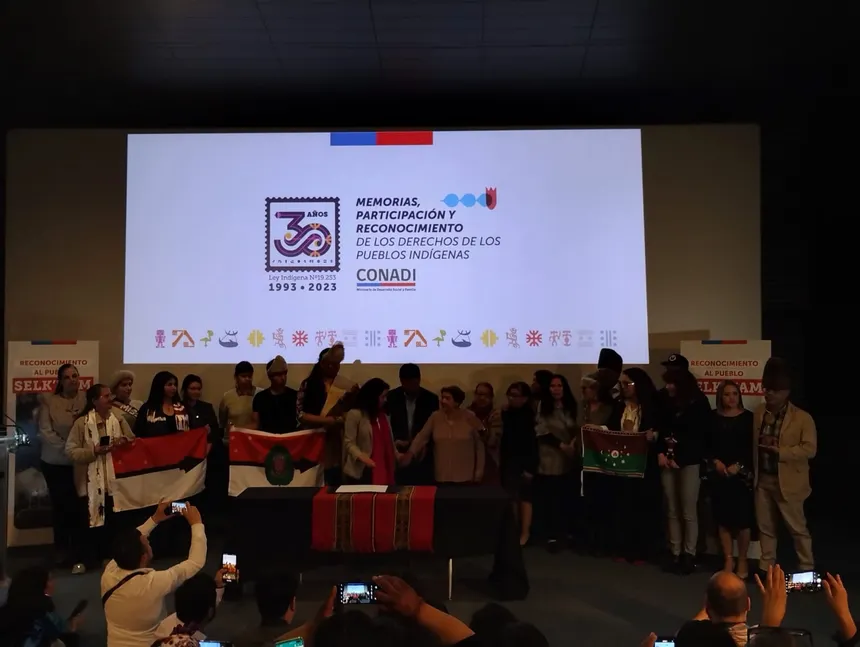
From the government's side, the Ministry of Social Development presented this reform as a form of reparation. Minister Javiera Toro spoke before Congress of a "historical debt" owed to the Selknam, recalling the State's responsibility in the policies that denied this people's existence and rendered their descendants invisible. On the occasion of the 30th anniversary of Law 19.253, CONADI chose to highlight this recognition as a "doubly historic" moment: the anniversary of the Indigenous Law, and the entry of the Selk'nam into the list of recognised peoples.
This institutional gesture is built on years of work by Selk'nam families. In Porvenir, the Covadonga Ona indigenous community — made up of Selk'nam descendants in Chilean territory — established the Corporación del Pueblo Selk'nam en Chile to represent the people on legal and political matters. Its mandate: defend collective rights, support legislative processes, and carry the voice of the families into spaces of negotiation with the State.
As early as 2019, the corporation submitted a bill specifically seeking to include the Selk'nam in Indigenous Law 19.253, with the support of indigenous legal scholars such as Ariel León Bacián. In parallel, other collectives — including the Telkacher community and the Fundación Hach Saye — were conducting fieldwork: language workshops, family research, and the reclaiming of narratives about the genocide and forced displacements.
A recent study, carried out in collaboration with the Fundación Hach Saye and the University of Chile, shows how these families mobilise law, art and ethnography to generate "new forms of struggle". Legal recognition becomes a lever for questioning access to ancestral territories, the restitution of indigenous place names in Tierra del Fuego, and the way Selk'nam history is taught in schools.
Selk'nam voices: between joy, caution and memory
In indigenous and allied media, the 2023 recognition is often described as "historic", but never as an endpoint. Servindi sums up the significance of the law by recalling that the Selk'nam become the eleventh indigenous people officially recognised by the Chilean State, after decades of official denial. This new visibility exists in dialogue with a history of violence: bounty hunts, forced displacements, confinement in missions and estancias, which marked the Great Island of Tierra del Fuego and the surrounding archipelago.
In an interview broadcast by El Mostrador and republished by Karukinka, young Selk'nam man Mauricio Astroza (Asamblea Telkacher) stresses the symbolic weight of this moment. For him, the legal recognition opens doors, but the challenge now is to defend a living culture, prevent the appropriation of Selk'nam symbols by institutions that do not work with the families themselves, and correct the notion — still present in some school textbooks — that the people has "disappeared".
At an official ceremony, the president of the Selk'nam Telkacher community, Ana María Muñoz, spoke of "mixed feelings": the joy of being recognised by the State and by Chile's other indigenous peoples, alongside the memory of generations who kept customs, stories and place names alive in a context of invisibilisation. The law has changed, but the work of reparation remains to be built, step by step, on the ground.
After recognition: what horizons?
Law 21.606 does more than add a name to a list. By updating the terminology of Law 19.253 towards "indigenous peoples", it brings Chilean law closer to the language of international instruments such as ILO Convention 169 and the United Nations Declaration on the Rights of Indigenous Peoples. This vocabulary opens the door to a more collective understanding of rights: political participation, territorial ties, protection of languages and knowledge.
Within this new framework, Selk'nam organisations are already advocating for concrete projects. In Tierra del Fuego, indigenous mapping projects for Selk'nam, Yagán and Haush territories explore how to rename landscapes using indigenous languages and historical pathways. A touring light artwork — Obra lumínica por el reconocimiento y la reparación del pueblo selknam — brings these questions of memory and justice to Porvenir and other southern cities, linking contemporary art, archives and family voices.
For the Selk'nam, the 2023 recognition thus marks a change of scale: from a people long described as "disappeared" in official discourse, to a living people, bearer of rights, knowledge and possible futures on their own land. For the Chilean State, it opens the obligation to build public policies in dialogue with these communities — not in their place.
The association Cape Horn au Long Cours and the website Cap‑Horniers Français now represent one of the most valuable independent resources for understanding the epic of large French merchant sailing ships and the seafarers who crossed Cape Horn. Through meticulous, volunteer‑driven research, the site documents vessels, voyages and crews, restoring a voice to these long‑distance sailors whose memory might otherwise have remained confined to archives and a few museum cases.
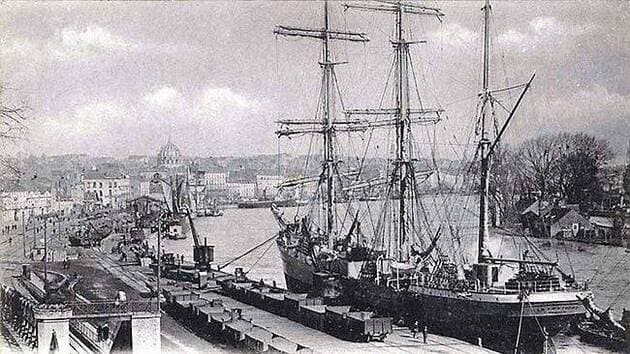
Nantes Port at the end of the 19th century (Quai de la Fosse) Le Coat Collection
A living memory of French Cape Horners
The term “Cape Horners” (or cap‑horniers) refers both to the large merchant sailing ships and the sailors who rounded Cape Horn between roughly the mid‑19th century and the 1920s, sailing between Europe and ports in the Pacific Ocean. These three‑ or four‑masted steel windjammers faced extreme conditions—fierce winds, heavy seas and freezing cold—especially when they beat against the prevailing westerlies to pass from east to west around the Horn.
For over a century, until the 1920s, the Cape Horn route was one of the great arteries of global maritime trade: French sailing ships carried guano and nitrates from Chile and Peru, cereals from Australia and California, lumber from North America, metals and nickel ore, among many other cargoes. Long before steam power and the Panama Canal, these tall ships shaped the commercial networks of the era, leaving behind a legacy of courage and endurance.
The Cape Horn au Long Cours association and its roots
The association Cap Horn au Long Cours (CHLC) inherits its spirit from the International Association of Cape Horn Captains (AICH), originally the Amicale Internationale des capitaines au long cours Cap‑Horniers, now dissolved along with the last generation of sailing‑ship masters who created it. Carrying on that legacy, CHLC has as its mission “to preserve and make known the heritage of the Cape Horners,” whether ships, routes, trades or human itineraries.
To fulfill this mission, the association launched and maintains the website caphorniersfrancais.fr, entirely devoted to French merchant sailors who sailed around Cape Horn under sail. The site states a clear, ambitious goal: to document, in the longer term, all the voyages of all the French Cape‑Horn sailors on all the French merchant sailing ships that rounded the Horn.
Independent, volunteer‑based documentation work
The work behind Cap‑Horniers Français is carried out in a fully independent, volunteer‑led manner. The team gathers and cross‑checks multiple sources: shipping company archives, logbooks, crew lists, travel journals, family photographs, private letters, and corrections or additions sent by descendants of sailors.
The site’s authors openly acknowledge the “monumental” scope of the task and the fact that it will take years of work, inviting the public to contribute documents, personal memories, or any corrections to existing entries. This participatory approach turns the project into a genuinely collaborative maritime‑history endeavor, where families, local historians and enthusiasts progressively enrich a unique documentary database.
Ships, voyages, crews: a growing corpus of documentation
One of the site’s main strengths is its effort to reconstruct, vessel by vessel and voyage by voyage, the itineraries and the lists of mariners aboard. The stated aim is to move Cape Horners beyond being anonymous silhouettes in old photographs and to see them as individual men, identifiable by name and placed back in the context of their long‑distance campaigns.
The site also highlights narratives and first‑hand accounts, such as the story of Captain Abel Guillou of the three‑masted steel ship Bretagne, wrecked at Cape Horn in August 1900 after two and a half months of battling the elements, with the crew later rescued by the British four‑masted windjammer Maxwell. These stories give concrete flesh to the dangers of the Cape Horn route and illustrate the values of courage, resilience and solidarity that the association wishes to transmit as part of the Cape‑Horners’ heritage.
Getting Cape Horners out of the museums
CHLC does not limit itself to an online database; it also seeks “to get Cape Horners out of museums” by bringing their stories directly to the public through conferences, temporary exhibitions, and various events held across France. These outreach activities rely on the association’s research to tell the history of long‑distance sailors beyond the display of objects, placing the human dimension—words, experiences and personal trajectories—back at the heart of the narrative.
This itinerant mediation helps reconnect port cities and maritime regions with their Cape‑Horn sailing heritage, especially in the towns and ports that played a significant role in the sail‑trade economy. It also offers descendants of sailors a space where they can rediscover traces of their ancestors and understand the concrete context of their voyages.
A major historiographical and heritage contribution
From a scholarly perspective, the work of Cap‑Horniers Français fills a gap between the “official” history of merchant shipping (statistics, fleet data, major trade routes) and the lived, often under‑documented history of crews at the individual level. By reconstructing voyages one by one and identifying the sailors, the association produces a fine‑grained micro‑history of sailing around Cape Horn.
This approach makes it possible to study recruitment networks, regional origins, the rhythm of voyages, long or short careers, wrecks and homecomings, and more broadly how the global economy of nitrates, cereals or timber translated into concrete human trajectories. It further provides a valuable resource for researchers in social history, maritime geography, port studies or maritime anthropology.
Cape Horn, a strategic node in global sail‑trade routes
To understand the association’s importance, it is essential to recall Cape Horn’s role in global maritime networks before the era of steam and the Panama Canal. From the late 15th century onward, and more intensively from the 19th century, powers seeking new maritime routes for spices, and later guano, nitrates and other raw materials, pushed their fleets south of the Americas.
Throughout the 19th and early 20th centuries, French Cape‑Horn windjammers regularly sailed between Europe and the Pacific, rounding Cape Horn twice a voyage in many cases. These routes were crucial for the nitrate and cereal trades, but they also demanded exceptional seamanship in the “Furious Fifties” and “Roaring Forties,” which explains the enduring prestige attached to Cape‑Horn sailors.
Nantes, a major ship‑owning port and Horn‑route hub
Within this story, Nantes occupies a special place as a major ship‑owning port and shipbuilding center on the Loire estuary. In the 19th century, shipyards around Nantes—including the Chantiers de la Loire and Dubigeon—built large steel sailing ships intended for long‑distance trade, including routes toward the Pacific and the Horn.
Nantes’ port landscape developed around the quays of the Loire, the activities of ship‑owners, river barge traffic, and large merchant vessels operating in an increasingly global economy. The presence of a Rue des Cap‑Horniers in Nantes symbolically underscores the city’s historic link with the sailors who departed on these extreme voyages.
The research carried out by Cap‑Horniers Français helps reconnect these port‑city realities with individual lives: many of the Cape‑Horn sailors, officers and captains featured on the site were from Nantes, Loire‑Atlantique, or other Atlantic ports, their careers scattered across registers, logbooks, and family testimonies that the association brings to light.
Saint‑Nazaire, an oceangoing gateway to the Horn
With the rise of the Port of Saint‑Nazaire in the middle of the 19th century under the Second Empire, the Loire estuary gained a modern oceangoing outport that gradually expanded and complemented the facilities further upstream. Created in 1856, Saint‑Nazaire became a key element of the greater Nantes–Saint‑Nazaire maritime port, featuring docks, dry docks, and later major shipyards.
Although Saint‑Nazaire is now best known for large‑scale shipbuilding, including cruise liners, its origins lie in a broader maritime and long‑distance economy, including the transit and outfitting of sailing ships bound for the Atlantic and the Pacific. At the height of the sail‑ship era, the Nantes–Saint‑Nazaire port complex formed one of France’s main gateways toward the South Atlantic, the Pacific, and therefore the Cape Horn route.
The work of Cap‑Horniers Français—by documenting ship by ship the campaigns to the Pacific—helps highlight this dimension: one can follow vessels built or owned in the region, crews recruited from coastal villages along the Loire, and the long journeys that ultimately led them to round Cape Horn.
A resource for researchers, institutions and families
The site is freely accessible and serves as a premier‑quality resource for historians, students, maritime museums, but also for genealogists and families seeking to trace an ancestor’s seafaring career. The fine‑grained level of information—ship names, campaign dates, itineraries, onboard narratives, testimonies—allows for both detailed and cross‑cutting kinds of research.
By making this corpus available, Cap‑Horniers Français also contributes to the valorization of maritime heritage for local authorities, ports, and memory‑related sites, which can draw on the data for exhibitions, urban routes, commemorations, or educational projects. In doing so, the association positions itself as a bridge between archives, territories and the wider public.
A call for contributions and the future of the Cape‑Horn legacy
With full awareness of the immensity of the task, the association emphasizes that this work is evolving and incomplete, inviting anyone who possesses documents, photos, notebooks, crew lists, or family stories to contact them and help enrich and correct the published information. This openness underlines the collective nature of the project: the history of Cape Horners is no longer reserved for specialists alone, but becomes a shared memory to which everyone can contribute.
At a time when commercial sailing has vanished before the rise of mechanical propulsion, this independent research stands as a bulwark against the forgetting of a maritime world now gone, yet one that has shaped French port cities, estates and coastal cultures from Nantes and Saint‑Nazaire to the distant shores of the Pacific. By rigorously documenting Cape‑Horn sailing ships and their crews, Cap‑Horniers Français provides an irreplaceable tool for understanding this history and transmitting it to future generations.
The Pacification of Araucania: a comprehensive analysis of invasion, dispossession, and Mapuche genocide
Chile's history contains a chapter written with euphemisms and blood: the misnamed "Pacification of Araucania." This article delves into the details of this process (1861-1883), deconstructing the official narrative to reveal a complex operation of military conquest, legal dispossession, and forced colonization that redefined the destiny of the Chilean state and the Mapuche people, leaving a legacy of conflict that persists to this day.
1. Historical context: autonomous Wallmapu and the expansionist Chilean state
In the mid-nineteenth century, the southern frontier of Chile was clearly delineated by the Biobío River. South of it extended Wallmapu, the ancestral territory of the Mapuche people, a de facto independent nation that had resisted Spanish conquest for more than 300 years. Mapuche society was organized into a complex social and political structure based on the lof (family clan), the ayllarewe (federation of lofs), and the butalmapus (large territorial alliances).
For the Chilean state, consolidated after the wars of independence and under the influence of European ideas of progress, this autonomy was a problem. Political and economic elites, under the presidencies of Manuel Montt (1851-1861) and then José Joaquín Pérez (1861-1871), viewed occupation as necessary to:
Appropriate resources: the lands of Araucania were considered the "granary of Chile."
Unify territory: connect the central zone to colonies in Valdivia and Llanquihue.
Assert sovereignty: eliminate the internal frontier and project an image of a modern nation.
2. Key actors in the conflict
This historical process was led by figures and groups with radically opposed interests.
Category
Main Actors
Role in the Conflict
Chilean State (Officials)
José Joaquín Pérez, Federico Errázuriz Z., Aníbal Pinto, Domingo Santa María
Presidents who drove the occupation policy
Chilean State (Military)
Col. Cornelio Saavedra, Gen. Gregorio Urrutia, Col. Basilio Urrutia
Chilean and European settlers, Orélie Antoine de Tounens
Occupied lands, pretext for conquest
3. The State's plan: Cornelio Saavedra's proposal
In 1861, Colonel Cornelio Saavedra Rodríguez presented to the Chilean Congress a detailed plan for the "Pacification of Araucania." He proposed abandoning the policy of treaties for material occupation, based on three axes:
Advance the military frontier from the Biobío to the Malleco, with forts.
Subdivide and sell "secured" lands.
Promote the settlement of Chilean and foreign settlers to "Chilenize" the region.
The plan sparked debate but was approved by Congress, triggering the invasion.
4. Military execution: phases of an asymmetric war
Military conquest unfolded in several phases, interrupted by Mapuche uprisings and the War of the Pacific.
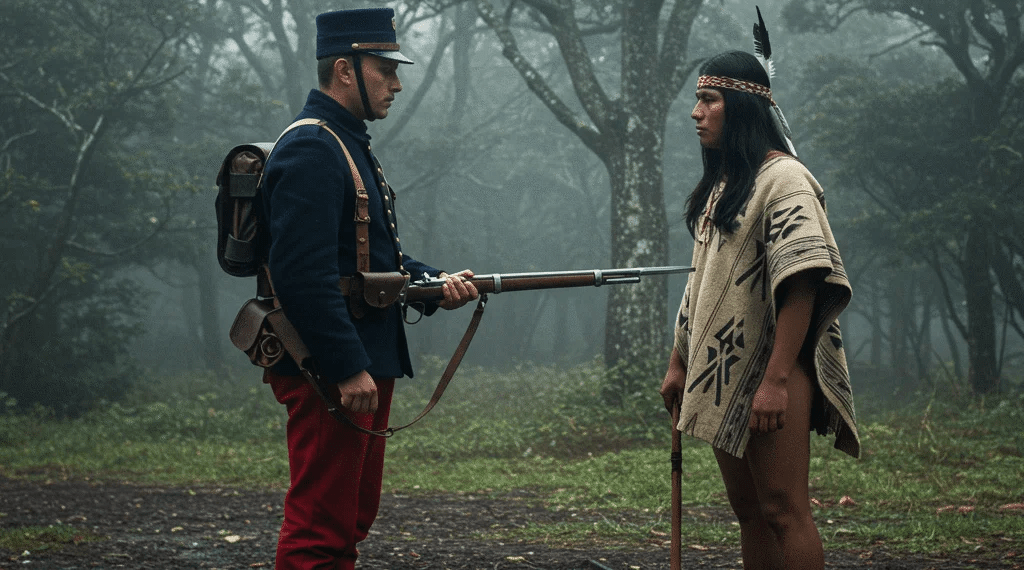
First Phase (1861-1868): Advance and Fortification Foundation of forts (Angol, Mulchén, etc.), immediate Mapuche resistance, "scorched earth" tactics applied by the army.
Second Phase (1869-1881): Diplomatic Pause and Consolidation Slowdown in advance, territorial consolidation, introduction of telegraph and railroad.
Third Phase (1881-1883): The Final Offensive Last major Mapuche uprising in 1881, massive military repression, founding of Temuco, military end of the "Pacification."
5. Legal dispossession: how laws annihilated Mapuche property
Military conquest was inseparable from legal conquest.
Radicación Law of 1866:
Definition of "vacant lands": any land not "continuously occupied" by indigenous peoples becomes state property.
Imposition of individual private property, foreign to Mapuche culture.
Creation of radicación commissions, a process rife with abuses and corruption.
"Títulos de Merced": Confinement in Reductions
Attribution of small portions of land (approximately 6 hectares per person), insufficient for traditional economy.
Loss of over 90% of Mapuche territory.
Social fragmentation and isolation of communities.
6. Directed colonization: land for some, dispossession for others
Treatment of the Mapuche People: confinement in reductions, lack of state support, status of "minors" under guardianship.
Treatment of European/Chilean Settlers: large parcels, state support (travel, tools, animals, medical assistance), status as full citizens.
7. The human catastrophe and the genocide debate
The "Pacification" was a human catastrophe that decimated the Mapuche population, fueling a debate about the term "genocide" according to the UN definition (1948).
Destruction of economy, dispossession of land, confinement in uninhabitable zones, massive famines and epidemics.
Ethnocide: destruction of culture through prohibition of language, religion, and autonomous education.
Historiographical Perspectives
Traditional: inevitable process for Chilean unification.
Revisionist: imperialist conquest, systematic violence, labeled ethnocide or genocide.
Mapuche: invasion of a sovereign country, beginning of a persistent colonial relationship.
Demographic Collapse
Between 20,000 and 30,000 Mapuche died of hunger and disease between 1881 and the early twentieth century.
The Mapuche population, estimated at half a million before conquest, suffered a demographic collapse from which it did not recover for more than a century.
8. Total impact: disarticulation of Mapuche society
The "Pacification" caused a structural rupture in all aspects of Mapuche life:
Political: loss of authority of the lonkos.
Economic: transition from a prosperous society to poverty.
Social: fragmentation and forced migration to cities.
Cultural: forced assimilation, threat to Mapuche language and worldview.
9. Mapuche resistance and resilience
Despite devastating circumstances, Mapuche resistance endured, transforming into political and legal struggles in the twentieth century. Memory and cultural identity survived clandestinely, testifying to remarkable resilience.
10. Legacy and historical debt: roots of current conflict
The "Pacification of Araucania" is the direct source of current conflict in Chile. The territorial and autonomy claims of the Mapuche movement rest on this historical dispossession. The "historical debt" is central to public debate, and recommendations for reparation remain largely unimplemented.
11. Comparative analysis: Araucania, the Argentine "Desert," and the American West
The Chilean process was not isolated:
Conquest of the Desert (Argentina, 1878-1885): similar ideological justification, total war tactics, objective of freeing lands for livestock.
Indian Wars (United States, nineteenth century): westward expansion, reservations, similar dispossession and violence.
In all cases, nation-states used their military superiority and a legal framework to dispossess indigenous peoples, leaving a legacy of trauma and struggle for justice.
Conclusion: a history to reclaim
The "Pacification of Araucania" was a war of conquest that dispossessed a people of their territory and sought to annihilate their culture. Understanding it in all its complexity is a duty for any society aspiring to justice. Recognizing this past is not reopening wounds, but beginning to heal them on the basis of truth and reparation.
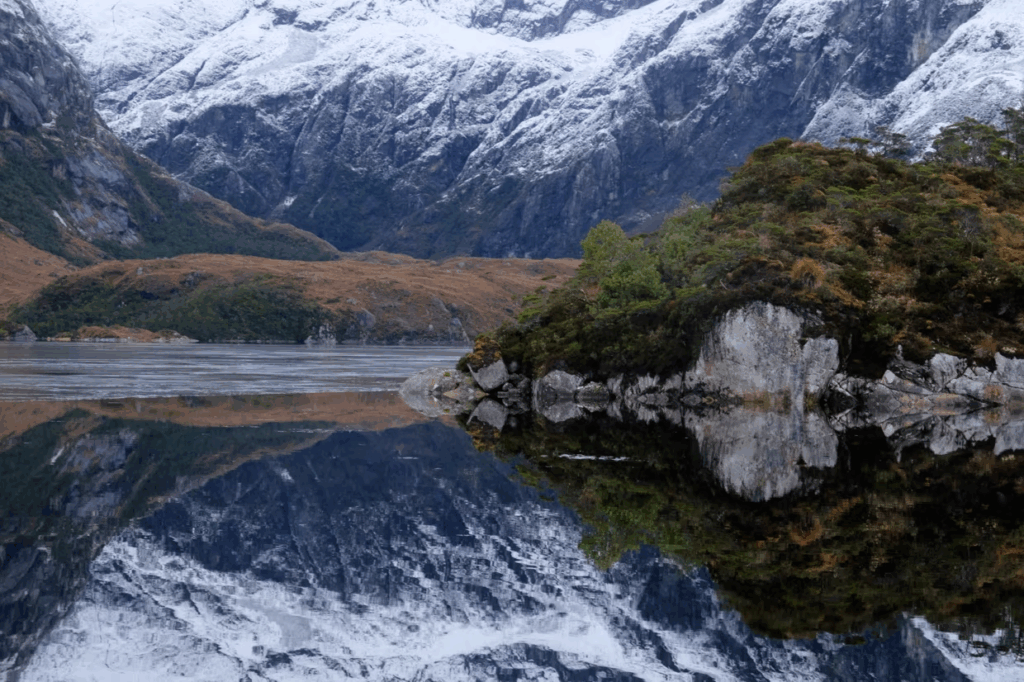
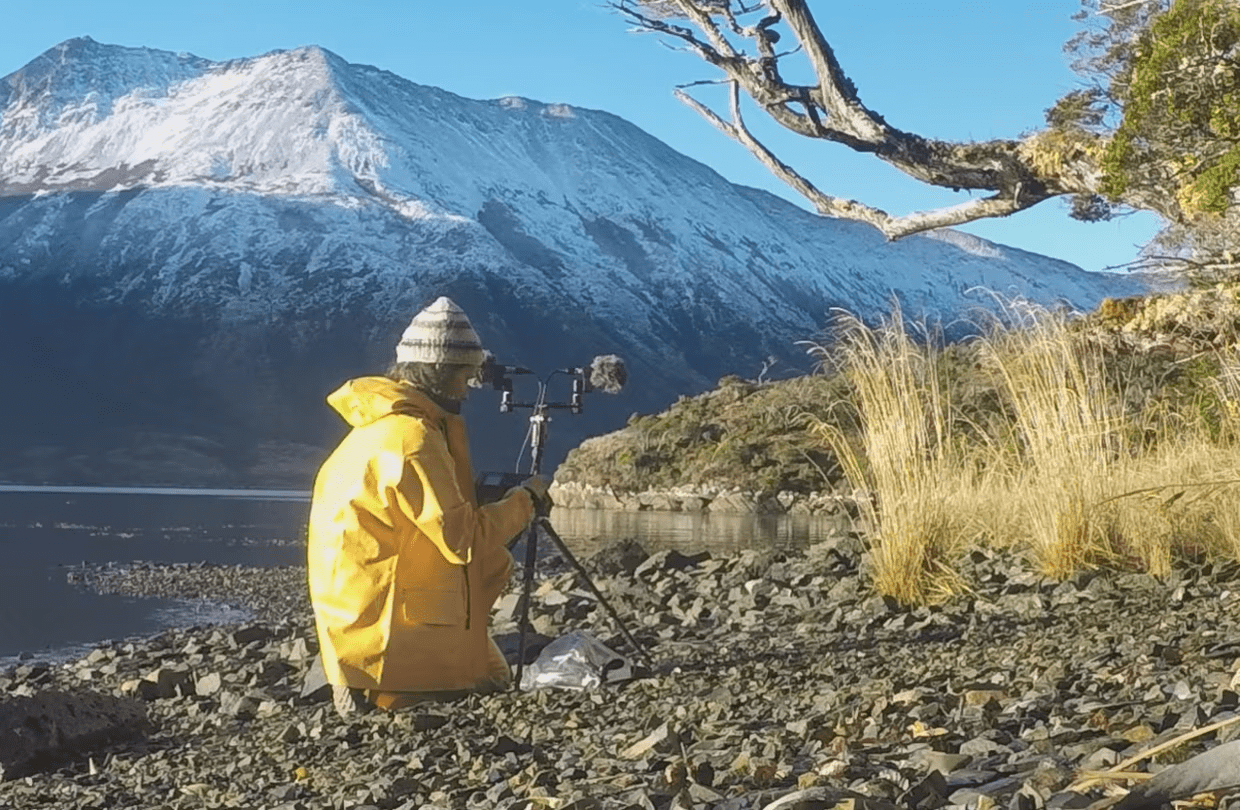
Ethno-acoustician Lauriane Lemasson is passionate about the relationships that peoples weave with their sonic environment. Her profession drives her, microphone in hand, to brave the harsh expanses of Patagonia. Her goal: to better understand the settlement dynamics and cultural sources of inspiration of the Indigenous peoples who once inhabited these remote regions before being decimated.
A land of silence and infinite spaces. In this Argentine Patagonian pampa, stretching out as if it would never end, people are few and not very talkative. There is no point in asking for directions. Apart from a few shaggy sheep who themselves seem to wonder what they're doing there, there is no one left to answer in these places.
In any case, south of 53° South, once past the bustling Strait of Magellan (or Magellan Strait), there is hardly more than a single real road on this gigantic archipelago that is Tierra del Fuego: Ruta No. 3, a licorice-colored ribbon winding from north to south, linking the town of Rio Grande to the port of Ushuaia. Otherwise, this antipode—one of the least populated in the southern cone of South America—consists of vast steppes speckled with dark lakes, unassailable mountains, and forests thrown to the margins of the ocean.
All on Foot
And to make matters worse, everywhere there are gnarled, half-bent shrubs twisted by the gusts, impenetrable thickets, lines of rusty barbed wire, and endless fences that seem to conspire to block access to the vast private estancias that still checker most of this land. That’s the setting: a void as staggering as it is hostile. And no welcoming committee.
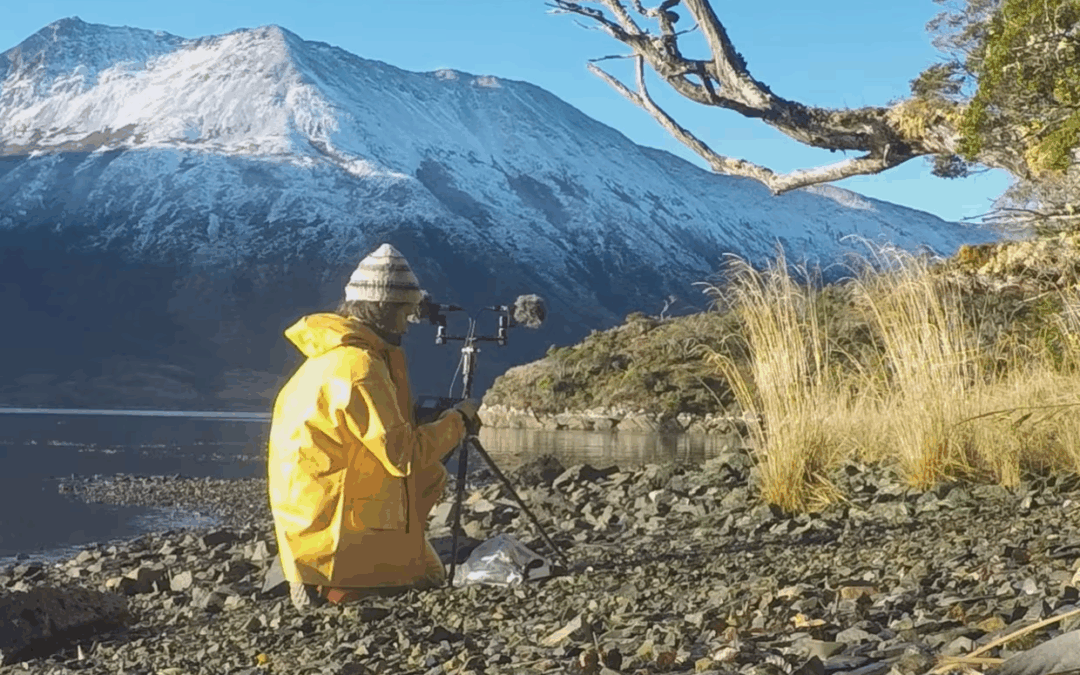
Yet it is in this complicated land that Lauriane Lemasson, 30 years old, has chosen to lose herself, alone, for months on end, traveling only on foot and always off the main marked road. This strong-willed young Breton woman has stepped over obstacles and ignored prohibitions in order to go “where no one goes anymore,” except for the gauchos. In short, a true wandering adventure. And in complete autonomy, burdened with a 25-kilo backpack in which Lauriane packed her gasoline stove, enough provisions to last between seven and nineteen days without resupply depending on the journey, her tent, her sleeping bag, her trusty Leica camera, her notebooks, and above all a host of microphones and recording equipment.
A Compass and a Map
She often forgot to look for shelter for the night—“in any case, most of the time there wasn’t any,” she recalls—and on her first escape, our tireless walker didn’t even have a GPS, just a compass and a good old 1:750,000 scale map. The goal of these rough outings? “To capture the sounds of the Patagonian landscapes,” she answers quite seriously. A strange quest, an unusual plan.
Because here, apart from the gusts that sometimes whistle so loudly they can make you deaf, silence and contemplation reign. “Very quickly, you realize that this space is inhabited by a thousand little sounds that truly sketch out the soundscapes I’m chasing,” Lauriane admits. The timid cries of birds, the plaintive creaking of trees in the storm, the grunting of sea lions, the distant cracking of glaciers… The slightest echo becomes, for our explorer, a kind of company.
The Violence of the Elements
“During my first journey across Tierra del Fuego,” she recalls, “over three and a half months of wandering, I met, outside urban areas, only three people: two estancieros, ranch workers who couldn’t believe they were seeing a Frenchwoman walking alone in the area, and an old Argentinian, a retiree who became my friend. He has since passed away, but he lived in isolation and welcomed me into his home without hesitation one day when the weather was very bad…”
Rain, snow, storms, blazing sun, sweltering heat, or chills rising from Antarctica… This region has always faced the violence and magic of the elements. Before it was discovered by the West during Magellan’s expedition in 1512, medieval portolan charts summed up the area with a few uncertain notes: “fogs,” “end of the world,” “anti-land.” But it takes more than that to throw off our adventurer. Because Lauriane is not just an explorer. And she’s certainly not a female Don Quixote chasing impossible windmills.
A doctoral student at the Sorbonne, she conducts her sonic explorations as part of a rigorous, multidisciplinary thesis in ethnomusicology and acoustics. This unprecedented research project, which she began in 2011, is based on an initial intuition that she continues to test during her expeditions in Tierra del Fuego: “My explorations between Rio Grande and Ushuaia, in the Corazón de la Isla provincial reserve near Lake Fagnano, on the Beagle Channel, and through the Cape Horn biosphere reserve are all founded on a conviction. The sounds of these places (soundscapes) can still teach us things about the Amerindian peoples who once inhabited them—provided we listen carefully to what they have to say,” she explains. Just as every corner of the planet has its particular smell, colors, and temperatures, an ambiance is also shaped by its acoustics.
“Everyone has experienced this,” the scientist points out. “Whether you are in front of a mountain, in a forest, in a desert, or at the center of an ancient theater, the soundscape influences how we occupy and perceive a place. This is what I try to understand, adding the filters of history, geography, and anthropology.”
From this perspective, analyzing the acoustic dimension of an archaeological site, an ancient Amerindian camp, or a sanctuary where shamanic rituals once took place makes it possible to better explain the past, or even to reconstruct part of the environment and culture of those who lived there.
Microphone in Hand, Ears on Alert
The researcher has traveled more than 2,000 kilometers on foot, driven by a single goal: to once again hear the echoes of the first Fuegian peoples, these Patagonian natives who are now virtually unknown to the general public. “Most books and articles on the subject claim that these Amerindians, who arrived in Tierra del Fuego more than 10,000 years ago, disappeared long ago,” Lauriane protests. “But from my very first trip, I realized the reality was quite different: descendants of these Indigenous peoples—exterminated by European colonists or forcibly assimilated into Hispanic culture—are still very much alive, whether in Argentina or Chile. Nor have their cultures and languages, though certainly threatened with imminent disappearance after years of being disregarded, been erased from memory.”
Based on this realization, the young researcher's quest took on an even greater sense of urgency. Supported in her work by the ethnologist and Arctic explorer Jean Malaurie—a legendary figure in the world of extreme adventure—Lauriane multiplied her sound recordings and acoustic tests. On this land now emptied of its first inhabitants, she uncovered forgotten campsites, as well as 2,500 hut locations. She even managed to reconstruct the original Amerindian place names of these sites, which had been replaced by the names given by the Spanish. All this painstaking work now allows Lauriane to suggest that in these ancestral societies, which were entirely oriented toward nature, shamanic chants and rituals were mainly inspired by the sounds made by animals, trees, waves, and winds.
Meeting the Yagans
The ethno-acoustician also set out to meet the last speakers of the Yagan, Haush, and Selknam languages in Argentina and Chile. This brought to life the accounts left by the few anthropologists who, at the start of the last century, took an interest in these Indigenous peoples—such as the missionary Martin Gusinde, who, in the 1920s, quickly set aside his evangelizing mission to immerse himself passionately in the daily life of the tribes. In 2018, during a new journey, Lauriane decided to focus her research precisely on the Yagans studied by Gusinde. This time, her destination was the Beagle Channel (Onashaga in the Yagan language). Unlike the Selknams and Haushs, who were hunter-gatherers, the Yagans lived on the water. They were nomads of the channels, traveling in long canoes and subsisting mainly on shellfish, which, according to old accounts, were harvested from icy depths by nearly naked women divers. The atmosphere changed entirely. This expedition took place in a maritime Tierra del Fuego, livelier and even windier than before, where the Atlantic and Pacific oceans meet head-on, often creating dramatic weather conditions.
A little further south of the Beagle Channel lies Cape Horn, renowned as the “official homeland of seasickness.” Then there are the famous caletas—fjords with spongy shores and trees draped in long strands of lichen, inlets carved out by glaciers thousands of years ago. These labyrinths wind westward, beyond Ushuaia, then along the Pacific coast of Chilean fjords and all the way to the Chiloé Archipelago. “Sailing is the only way if you want to land on the islets and coves scattered everywhere,” Lauriane notes. “My initial idea was to wander by canoe like the Yagans, but technically the expedition was too complex and very risky.” So, she joined a French family as a crew member on a sailboat for a three-month expedition. They stocked up and set sail from Ushuaia, then crossed the closely monitored border waters patrolled by the Chilean navy for a first stop in the world’s southernmost port: Puerto Williams, on Chile’s Navarino Island, a major center of Yagan culture. From there, they headed west, zigzagging through the two arms of the Beagle and exploring the shores on foot to catalog the campsites.
For this journey, the acoustician improved her sound investigation tools: microphones capable of recording in all directions, the latest recorders, meticulous protocols, and… a simple wooden box! Bought at a hardware store in Ushuaia, the object is the size of a shoebox. By tapping on its lid, like a drum, it produces a sharp, loud noise that resonates in the emptiness—perfect for testing the echo of a place and analyzing how sound travels through a given site. Inspired by the protocol developed in 1967 by François Canac (a French scientist who worked notably on the acoustics of Roman amphitheaters), this kind of box test helps better understand sites once occupied by the first inhabitants.
A Crucial Discovery
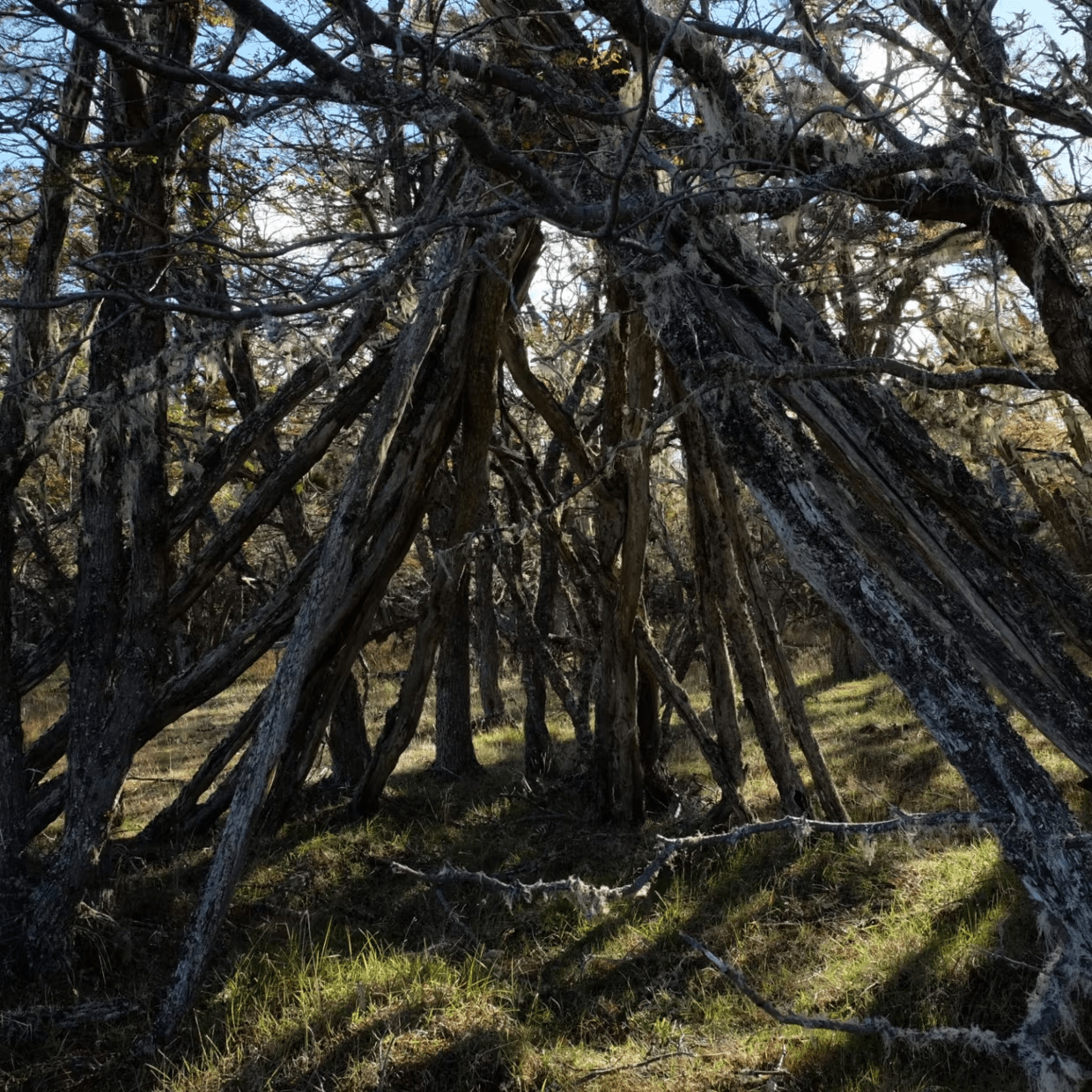
After leaving the boat, Lauriane returned to the steppes for two more months of solitary research. Then, last April, during her latest expedition, she made her most important discovery in the center of Tierra del Fuego. She headed to the Ewan I site, once used by the Selknam for the Hain initiation ritual for young adults. Studied by the anthropology and archaeology laboratory of Cadic (the Southern Center for Scientific Research in Ushuaia), the site still has a ceremonial hut standing, dated to 1905. “There,” Lauriane recounts, “I was able to carry out acoustic tests to understand the placement of this hut. Located on the edge of an old clearing, Ewan I actually functions like an amphitheater, where sounds (songs, words, cries) are absorbed, conducted, or deflected by the terrain. It is likely that these effects were not accidental but were considered in the choice of the ritual site to ensure the ceremony went smoothly.” This sheds new light on the acoustician’s university thesis. “Tomorrow, we’ll be able to explain other sacred sites by analyzing how they resonate,” she says enthusiastically, already thinking about her next trip. It will be soon, and perhaps aboard her own little sailboat. “I dream of crossing the Atlantic,” confides our Breton. Before once again setting course south, toward that Fuegian land that still has so many sonic nuances to whisper to her.