
Indigenous mapping
Gathering and mapping Yaghan, Selknam, and Haush toponyms

A territory at the edge of the world, inhabited for over 10,000 years
For more than a decade, Karukinka's expeditions have carried us to the planet's extremes — to places where nautical charts still bear the enigmatic label "uncharted." From the turbulent waters of the Strait of Magellan to the glacial labyrinths of the Patagonian channels, from wind-lashed Tierra del Fuego to the treacherous Le Maire Strait, each mission unveils landscapes shaped by natural forces over millennia.
These territories, spanning thousands of square kilometers up to the Cape Horn Biosphere Reserve, stand among the last wild sanctuaries on Earth. Yet their apparent wilderness conceals a more complex truth: these lands were home to civilizations fully adapted to one of the planet's most inhospitable environments.
Archaeological research has established that the main island of Tierra del Fuego was first settled more than 10,000 years ago, when Amerindian hunters-gatherers crossed the Strait of Magellan before its full opening, when it could still be traversed on foot. Further south, maritime nomads reached the Cape Horn archipelago in the early centuries of the Common Era, spreading from a founding population centre established in the Murray–Ushuaia channel approximately 6,000 years BP.
Three Fuegian peoples: hunters, navigators, guardians
Three distinct peoples shared this extreme territory, each developing a remarkable adaptation to their environment:
- The Selk'nam (Onas), terrestrial hunters-gatherers, occupied the main island of Tierra del Fuego — its steppes and mountainous interior — except for the Mitre Peninsula. Before the colonization, their territory was organized into family units called haruwen, with precisely known and respected boundaries. Their patriarchal society was structured around the Hain, a male initiation ritual.
- The Yaghan (Yámana), accomplished maritime nomads, navigated the channels and archipelagos south of the Strait of Magellan, from the Beagle Channel all the way to Cape Horn. They travelled by canoe through a labyrinth of islands and fjords, developing an intimate knowledge of currents, winds, and marine resources.
- The Haush (Manekenk), guardians of the Mitre Peninsula, spoke a language distinct from Selk'nam but shared many cultural traits with them — close enough to be integrated into several of their rituals, including the Hain.
The principal scientific accounts of these peoples were collected by Thomas Bridges (Anglican missionary, founder of Ushuaia, author of the Yamana–English Dictionary, active 1870–1898), Paul Hyades during the French Scientific Mission to Cape Horn (1882–1883), Martin Gusinde (Polish ethnologist-priest, present in Tierra del Fuego from 1918 to 1924), and Anne Chapman (Franco-American anthropologist, student of Lévi-Strauss, who worked alongside the last Selk'nam speakers during the 1960s and 1970s).
A colonial genocide, a memory to preserve
The silence now echoing across these deserted expanses speaks tragically of the methodical genocide carried out between the second half of the 19th century and the first half of the 20th. The large-scale introduction of sheep farming — particularly driven by estancieros such as José Menéndez — transformed ancestral lands into private properties, and turned the Selk'nam into legitimate targets as alleged "sheep hunters." Bounty hunters were paid per ear or per head; strychnine was used to poison guanacos and sheep carcasses left within reach of indigenous peoples.
In fewer than fifty years, thousands of lives were extinguished, taking with them irreplaceable ancestral wisdom, unique languages, and worldviews. The Selk'nam population, estimated at around 4,000 individuals at the dawn of the 20th century, was nearly wiped out. At the same time, Yaghan communities were decimated by diseases imported from Europe.
This poignant absence renders every expedition a memorial pilgrimage. Each camp beneath the southern stars, each anchorage in a forgotten cove, becomes an opportunity to honour the first inhabitants and keep their memory alive.
An archivistic and ethnographic detective mission (since 2017)
It is in this spirit that Karukinka launched, as early as 2017, a genuine work of archivistical and ethnographic investigation, deepened and expanded with the support of institutional partners. Armed with cameras, GPS, high-fidelity recorders and microphones, and driven by a passion for exploration, we travel on foot and by sailboat to the most remote corners of these lands to document what the places, winds, and waters can still reveal.
This exhaustive survey has already identified and precisely geolocated thousands of sites: traditional shelters (conchales), seasonal camps, ceremonial grounds, hunting stations, and passage points. Every GPS coordinate logged, every photograph taken, every sound recorded is a piece of the giant puzzle being patiently reassembled.
Over 3,000 place names collected, geolocated and analysed
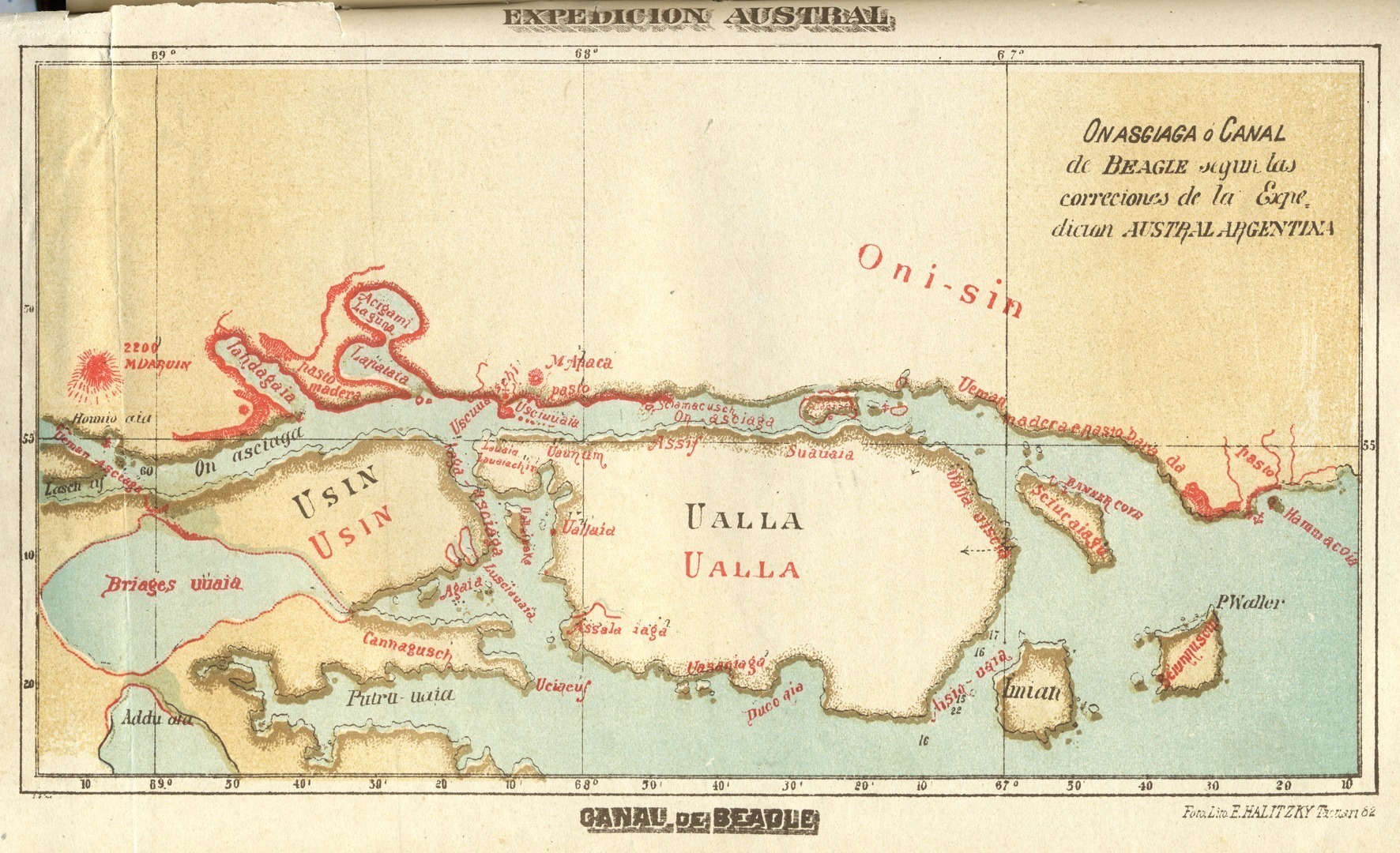
Alongside fieldwork, Karukinka has built a unique toponymic database containing over 3,000 place names in Selk'nam, Yaghan, and Haush languages. This database is built by cross-referencing more than 35 sources, including Martin Gusinde's field notebooks, Anne Chapman archives, Thomas Bridges' archives, and official Argentine and Chilean maps.
Some of these names, orally transmitted by the last fluent speakers before their passing, had never been mapped. Others, mentioned in 19th- and 20th-century explorers' journals, awaited precise relocation via GPS coordinates.
Each entry in the database includes:
- the name in the original language (with spelling variants from different sources)
- etymology and meaning, where known
- the geographic type of the feature (mountain, lake, river, bay, cape, campsite, etc.)
- precise geographic coordinates
- the primary sources that documented the toponym
- a narrative commentary on its history or mythological significance
For example, the Mount Akelkoyen (the "Red Clay Head") is named after Kwanyip's mother — son of the sun and Selk'nam mythological hero — its name derived from kel, the red clay the Haush used to paint their bodies.
This living cartography gradually reveals the unsuspected richness of Fuegian human geography: here, a promontory was called "the cordillera of infinity leading to the ancestors"; there, a massive rock marks the place where Kuanip, the Selk'nam creator deity, hurled stones against intruders.
A multidisciplinary and collaborative approach
This work of remembrance could not exist without the invaluable collaboration of researchers, members of the Fuegian peoples, and seasoned guides who generously share their knowledge and deep attachment to these ancestral lands. Together, meticulous archival work is carried out, cross-referencing historical documents, oral testimonies, ethnographic data, and field observations.
Partners and collaborators include:
- Selk'nam and Yaghan peoples from Argetina and Chile, such as Mirtha Salamanca and her family, José German Gonzalez Calderon and Cristina Calderón (died in 2022 and recognised as one of the last fluent speakers of Yaghan
- Archives held in Europe, for example at the Bibliothèque nationale de France (Scientific Mission to Cape Horn, 1882–1883), the Muséum National d'Histoire Naturelle de Paris, and the Ethnographic Museum of Berlin
This multidisciplinary approach progressively restores meaning to territories that official history had drained of their original significance and spirit.
The call of responsible exploration
Today, these extraordinary spaces reveal themselves far from classic tourist circuits. These privatised or abandoned lands open only to authentic explorers willing to face the extreme conditions at the world's end for a transformative experience.
To join our expeditions is to engage in a quest for meaning and to contribute to preserving a unique intangible heritage. It is also to honour the memory of the lands' first inhabitants and carry their legacy forward to future generations.

Follow us
Contact
contact@karukinka.eu
+33 2 40 56 31 95
+33 6 72 83 03 94