He works bone and bark the way others work the wood of a violin: with the memory of gestures passed down through generations, more than through mere technical skill. José German Gonzalez Calderon, fishing captain, former president of the Yagan community of Chile and honorary member of our association, is exceptionally opening for sale a series of pieces crafted by his own hands: whalebone harpoons and sewn coihue-bark canoes, made using the ancestral navigation and hunting techniques of the Yagan people of the Fuegian channels.
Karukinka is pleased to present this preview sale, open to members of the association, to enthusiasts of southern cultures, and to museums wishing to acquire collection pieces.
José German Gonzalez Calderon, keeper of a recognized craft
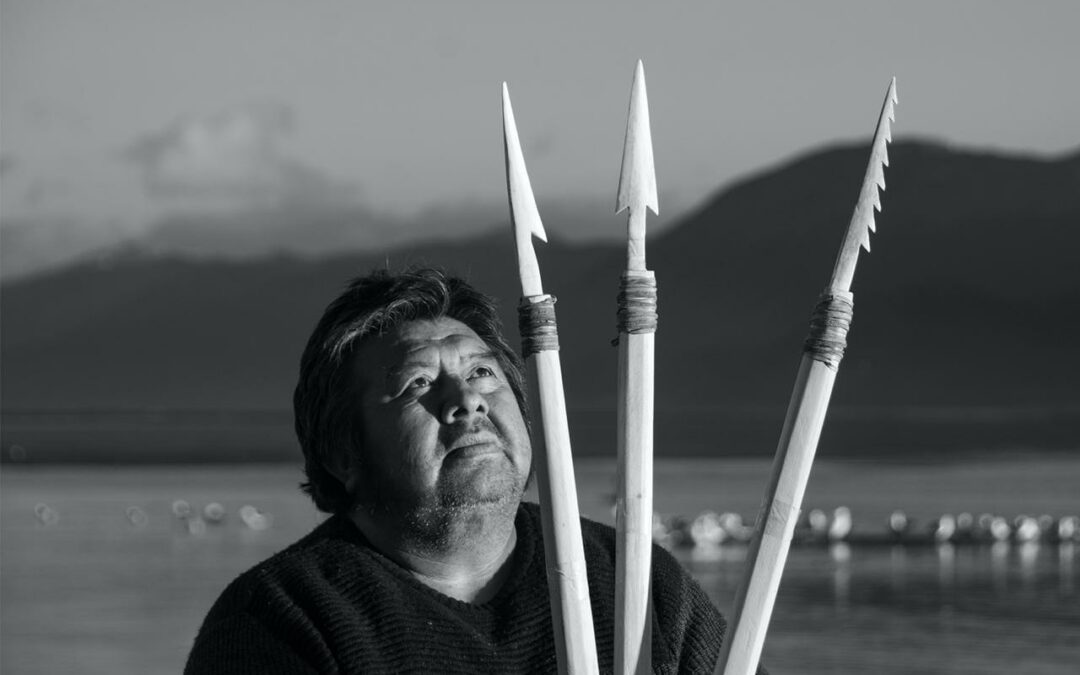
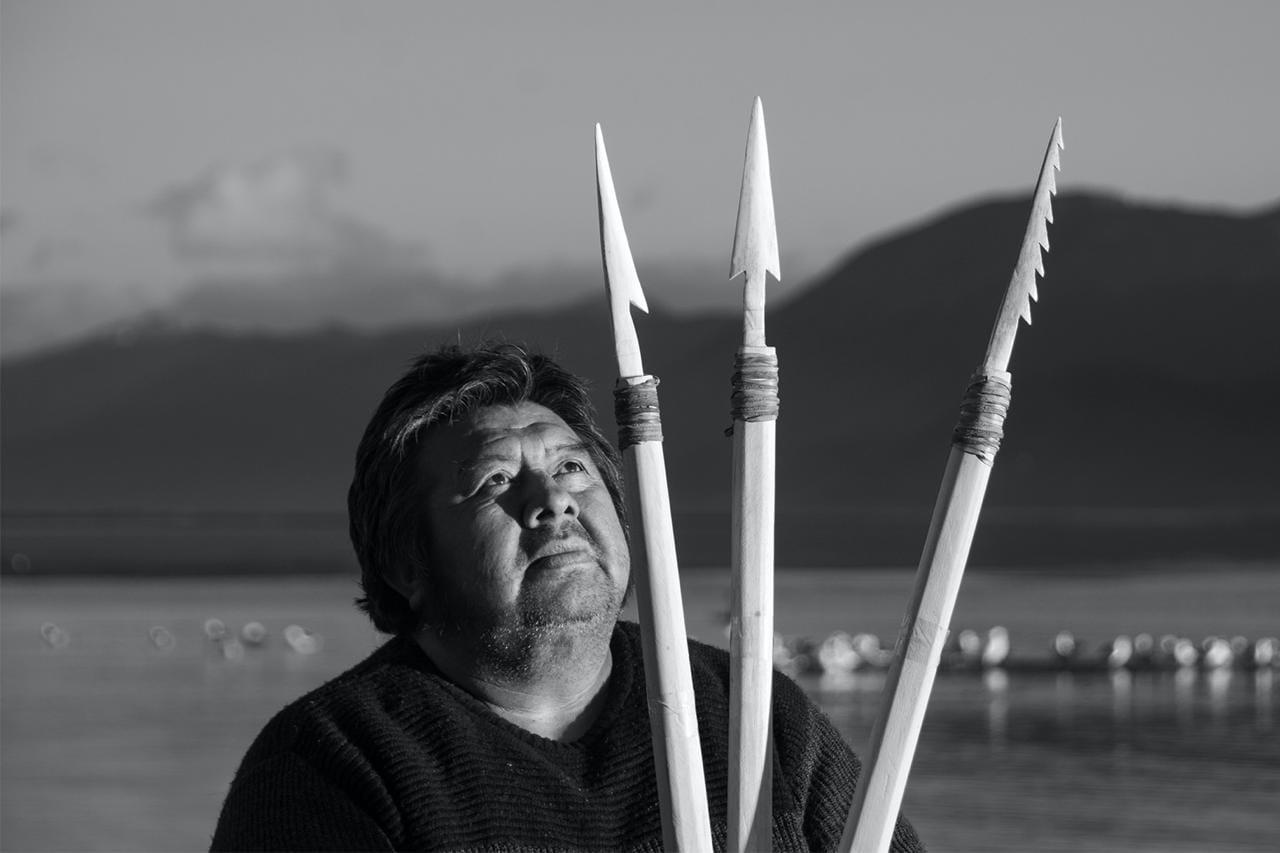
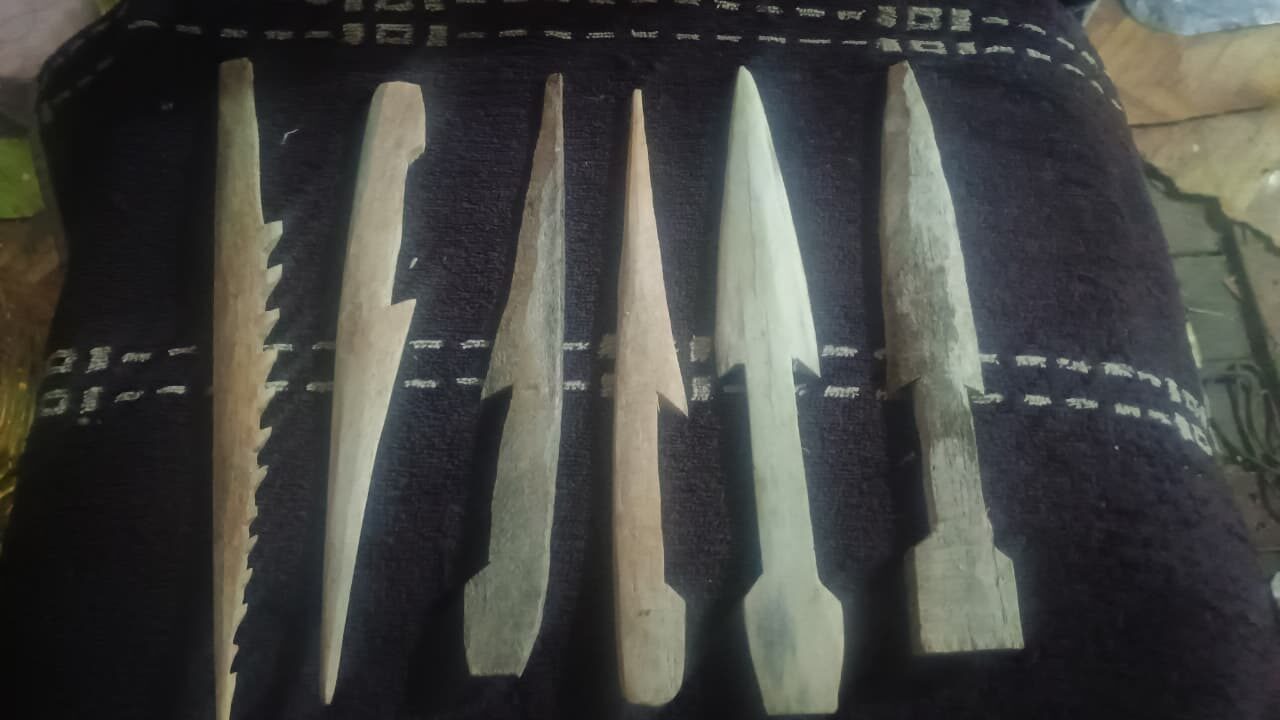
Portrait of José German Gonzalez Calderon, Yagan artisan, with his creations: three whalebone harpoons (photograph by Omar Barroso)
José belongs to the last generation of Yagan navigators who grew up living a nomadic life, in direct contact with the traditional techniques of boatbuilding and maritime hunting practiced in the channels of Cape Horn. He is the godfather of the sailing vessel Milagro, the association's expedition platform in the channels of Patagonia and as far as Cape Horn, and the living link between Karukinka's scientific programme and the embodied knowledge of his people.
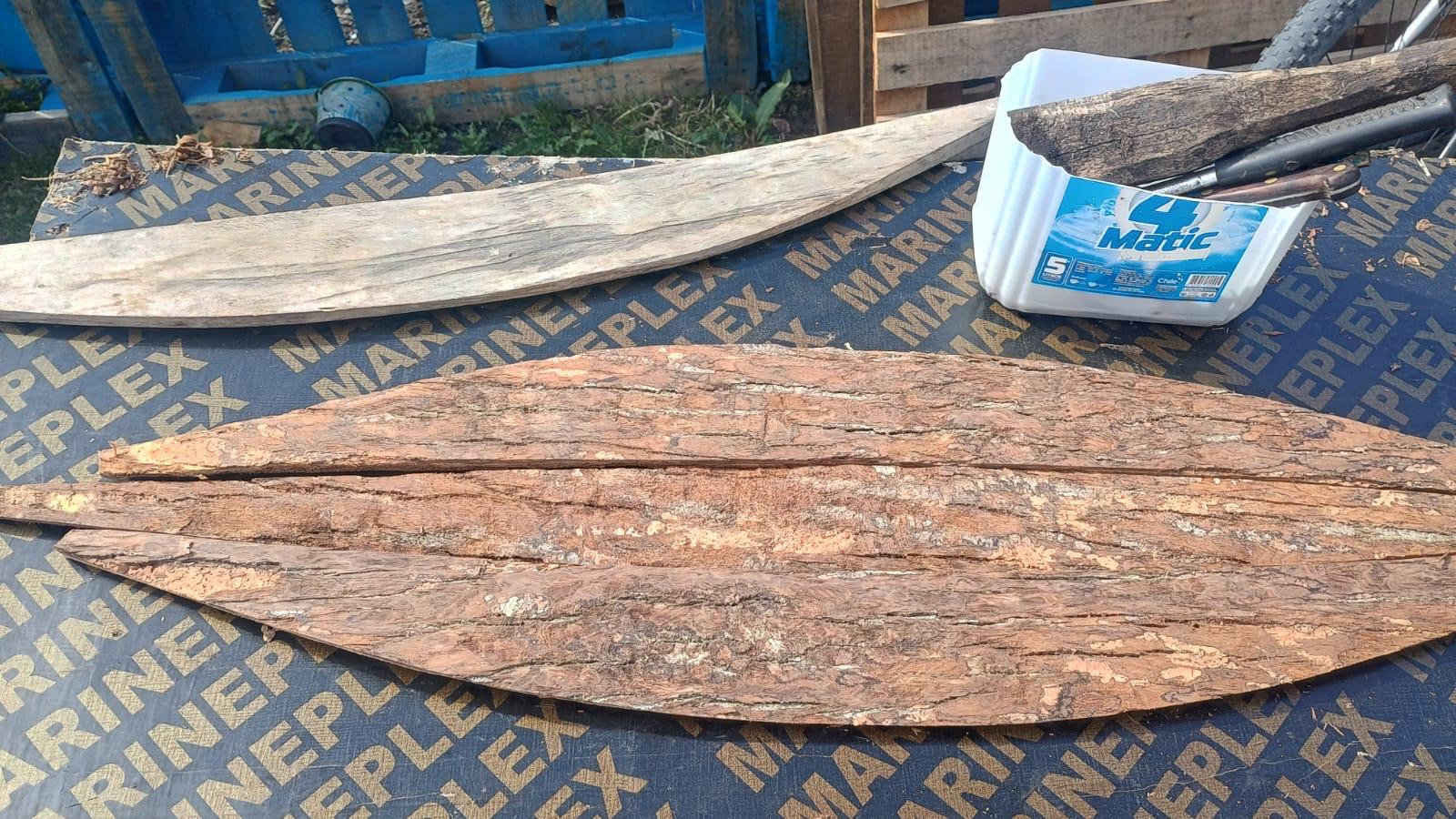
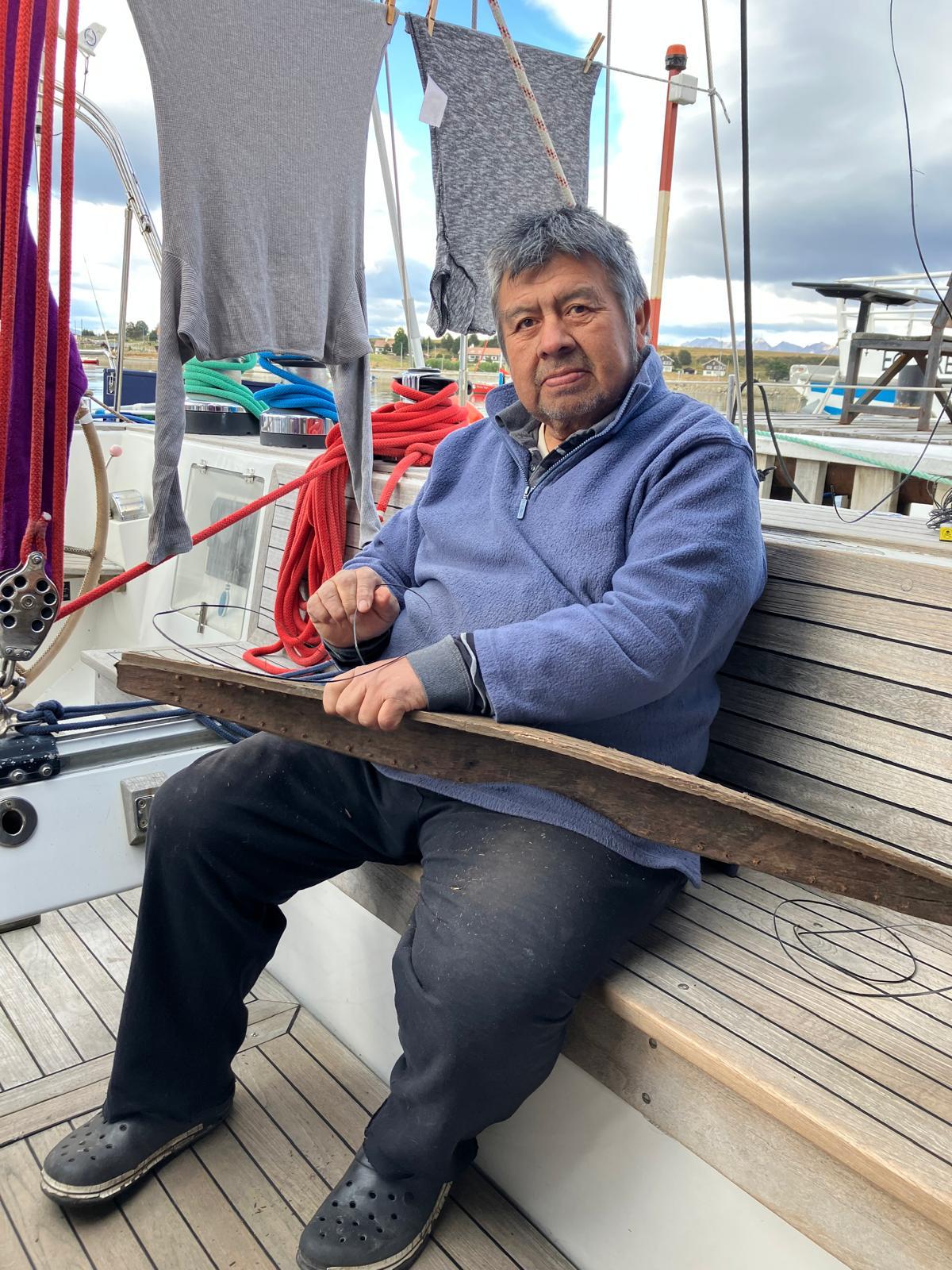
Cutting coihue bark......and assembling it aboard Milagro!Yagan whalebone harpoons crafted by José German Gonzalez Calderon
His craftsmanship — the sewn assembly of coihue-bark panels for canoe construction, and the shaping of whalebone for hunting harpoons — is recognized by UNESCO as part of efforts to safeguard the intangible cultural heritage of southern Indigenous peoples. This recognition attests to the heritage value of gestures that very few people are still able to reproduce today.
Canoes of varying sizes, accompanied by their emblematic pieces
Each canoe offered for sale is unique: José crafts them in different sizes, depending on requests and the time required for their making. No two pieces are identical, which gives each canoe the status of a collector's item in its own right.
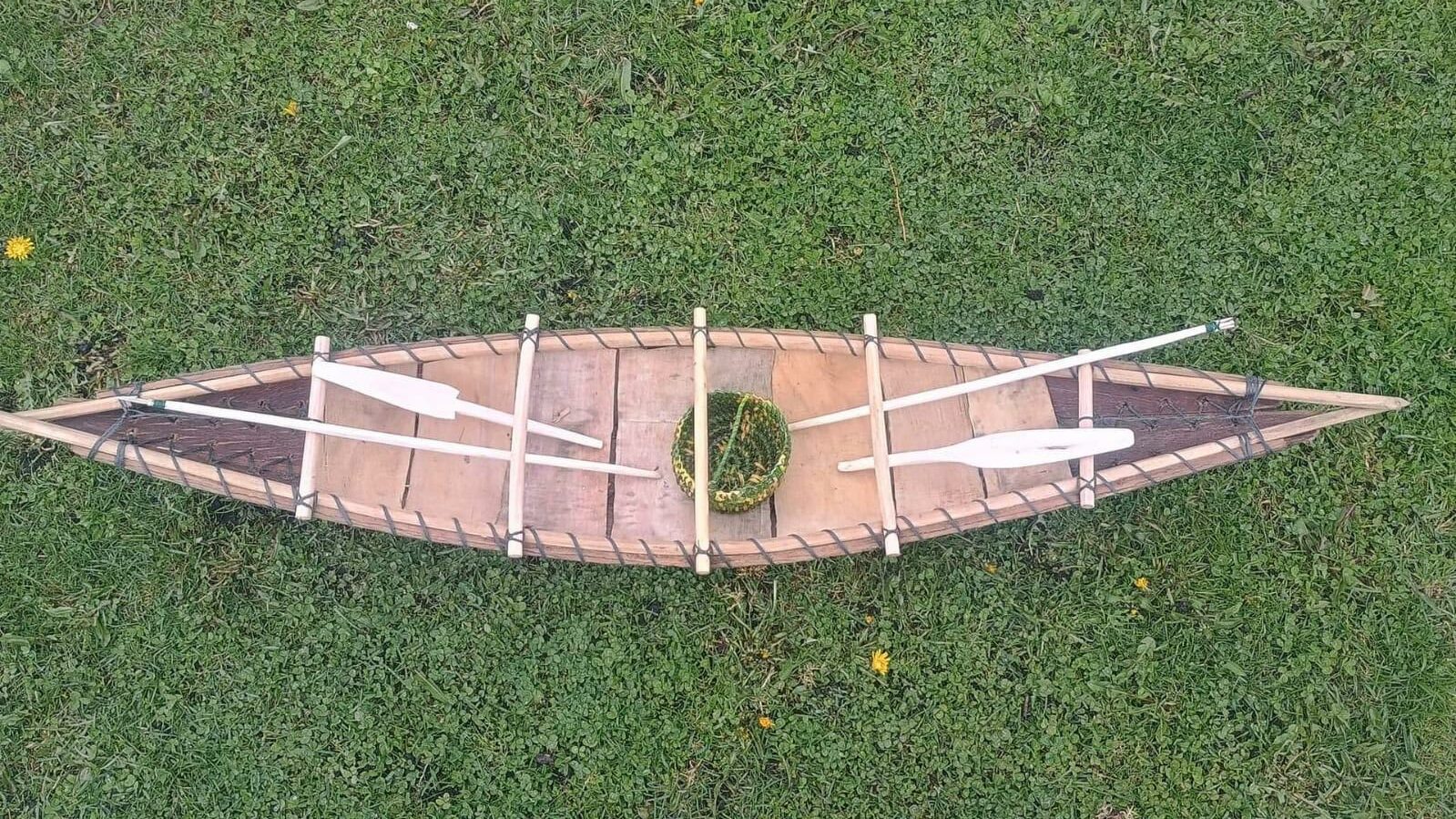
Each canoe comes with a set of miniaturized emblematic pieces, faithfully reproducing the everyday tools and objects of Yagan maritime life:
A man's paddle and a woman's paddle, with distinct shapes according to traditional use.
A miniature harpoon with a whalebone tip, a faithful reproduction of the hunting harpoons.
A sea-urchin claw, a traditional tool for marine gathering.
A woven rush basket, used for collecting and transporting resources.
Bark canoe with miniature emblematic pieces made by José
This complete set makes it possible to grasp, through a single piece, the diversity of Yagan navigation and subsistence knowledge and daily practices.
Pieces exhibited at the Museo Chileno de Arte Precolombino in Santiago
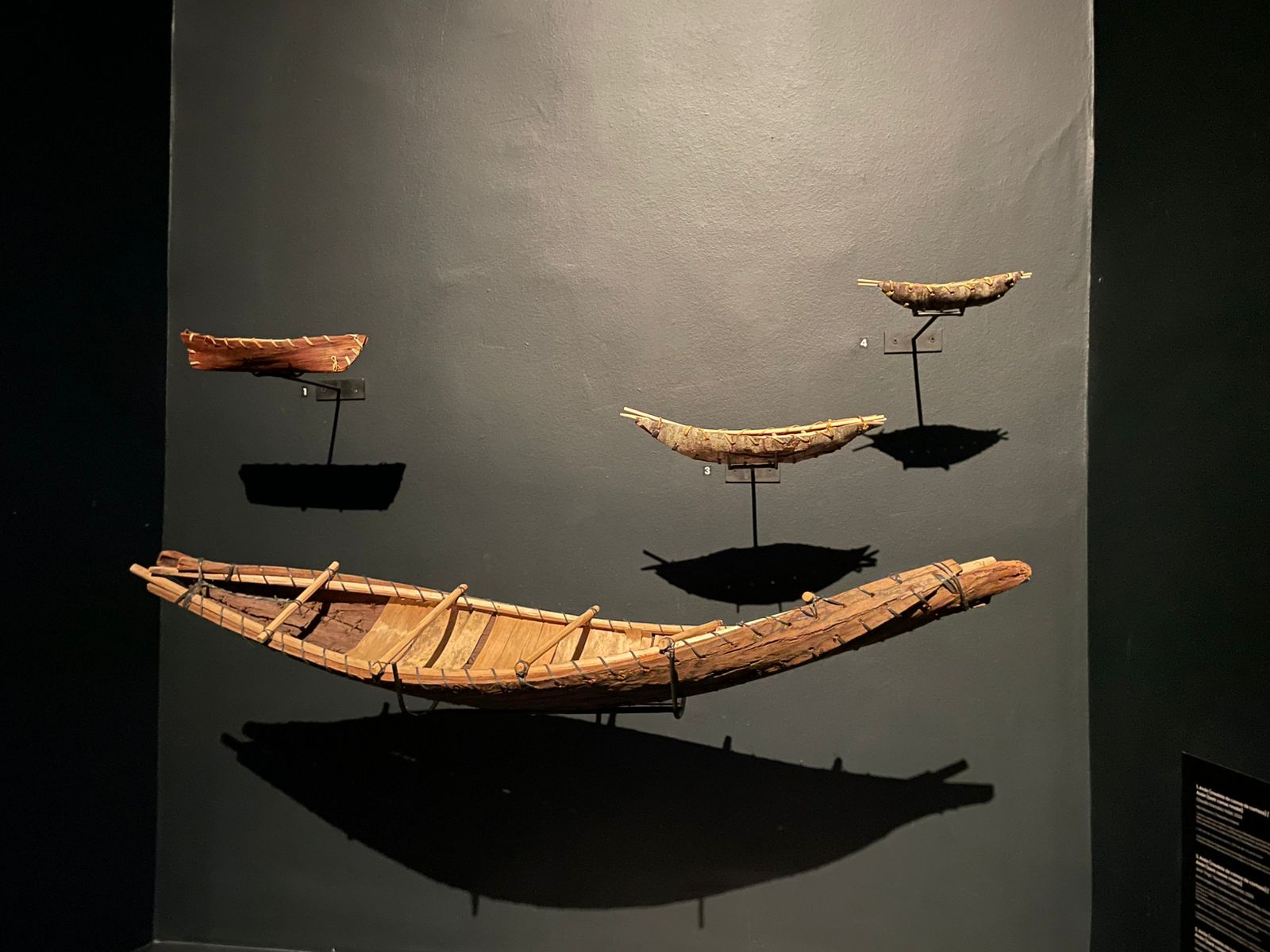
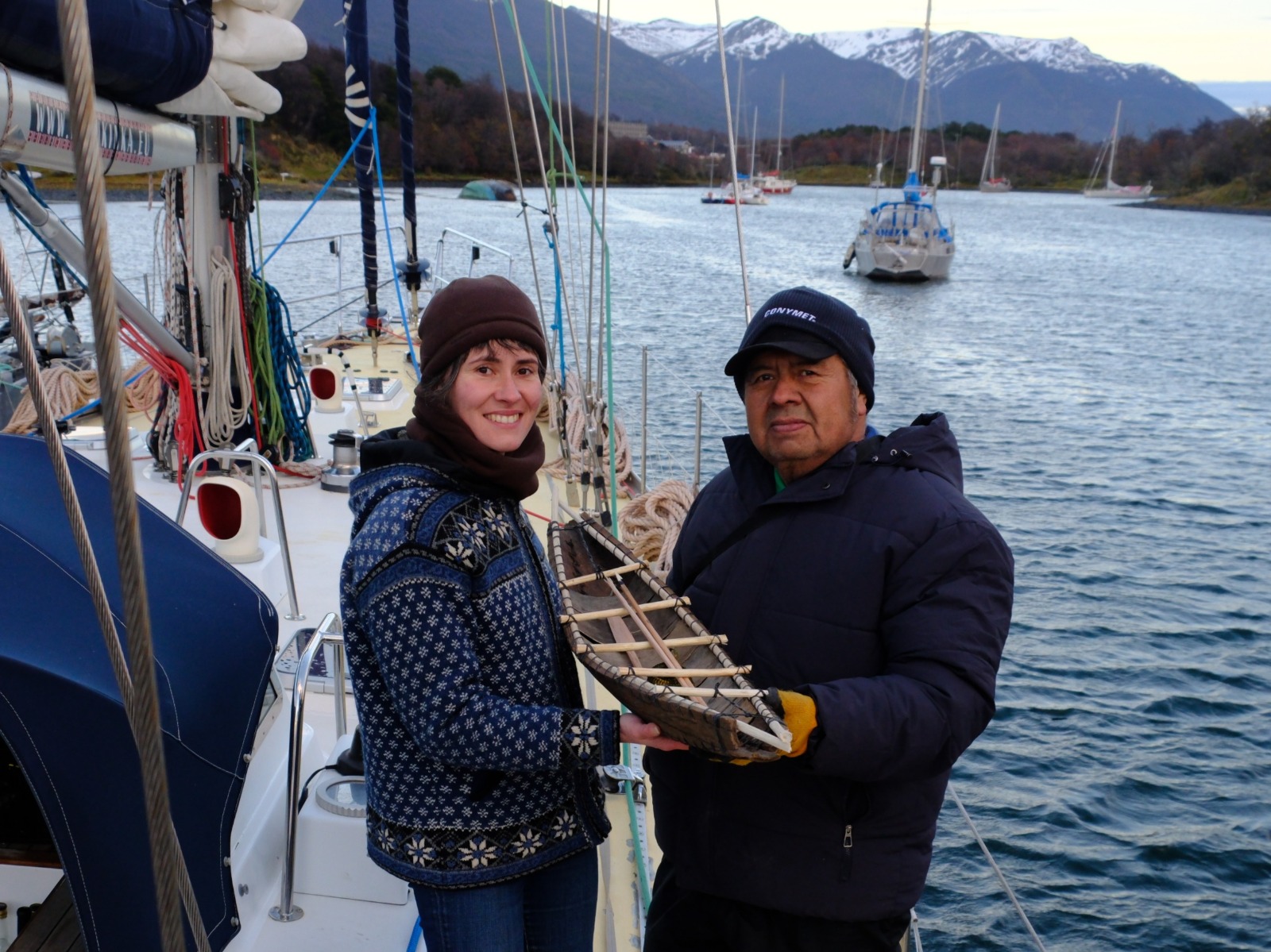
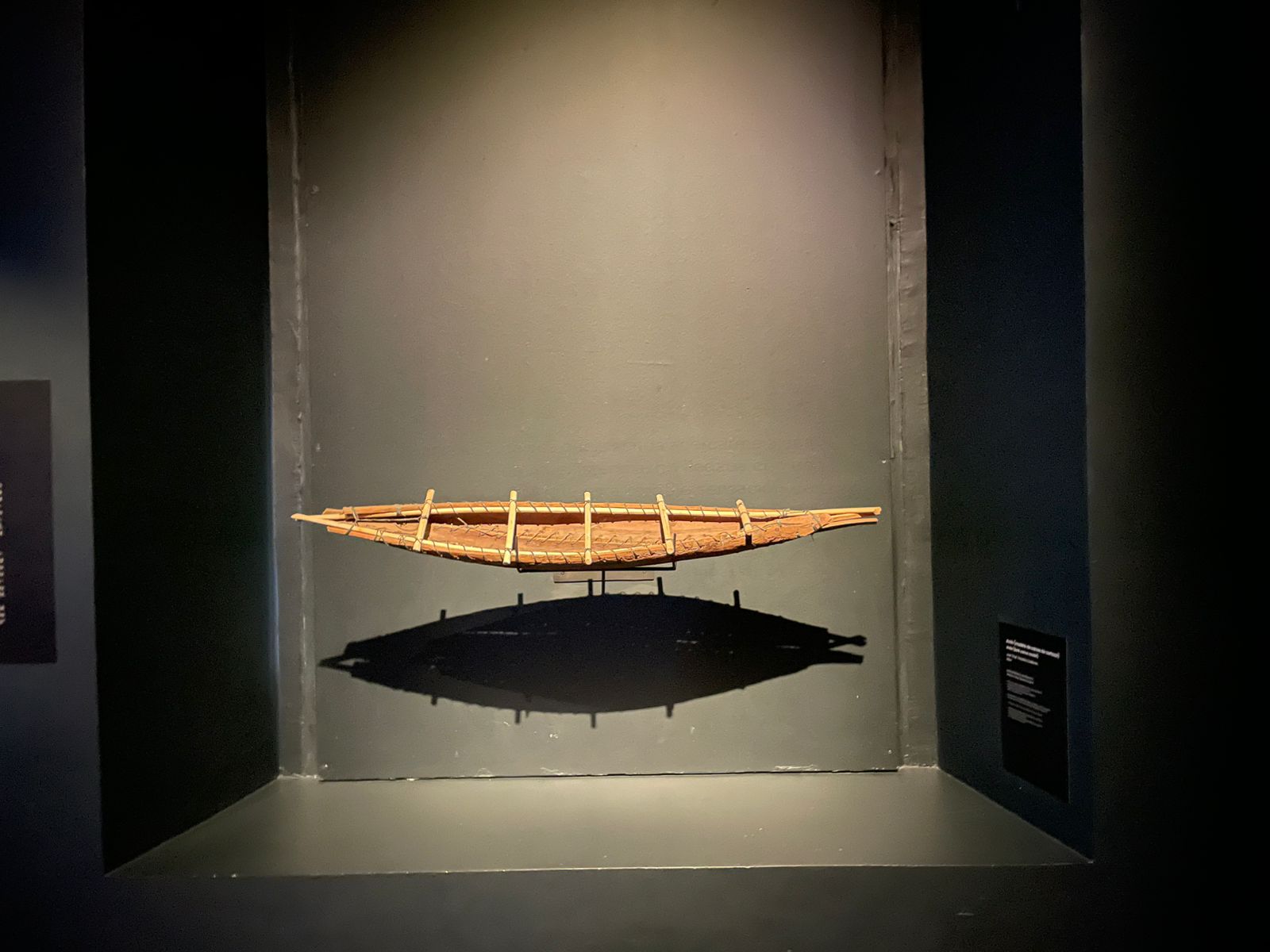
Among José's creations are harpoons and one exceptional piece: a canoe about sixty centimetres long, exhibited at the Museo Chileno de Arte Precolombino in Santiago last April, and which has accompanied Milagro's crew since the end of May between Puerto Williams and France.
The canoe's return aboard the sailing vessel Milagro after its exhibition in Santiago. Lauriane Lemasson and José German Gonzalez Calderon (c) Damien Treutenaere
The museum's team agreed to lend this piece to the association so that it could be shared with as many people as possible over several months, including during the presentation of the association's work on Indigenous toponymy last June in Montpellier (International Conference on Inclusive Toponymy, co-organized by the UNESCO Chair in Toponymy).
This collaboration illustrates the institutional recognition enjoyed by José's creations, whose pieces naturally find their place in museum collections devoted to pre-Columbian and southern cultures.
José's Yagan canoe, exhibited at the Museo Chileno de Arte Precolombino in Santiago (April 2026)
The pieces on offer
Whalebone hunting harpoons.
Sewn coihue-bark canoes (varying sizes), each accompanied by their miniaturized emblematic pieces (man's paddle, woman's paddle, miniature harpoon, sea-urchin claw, woven rush basket).
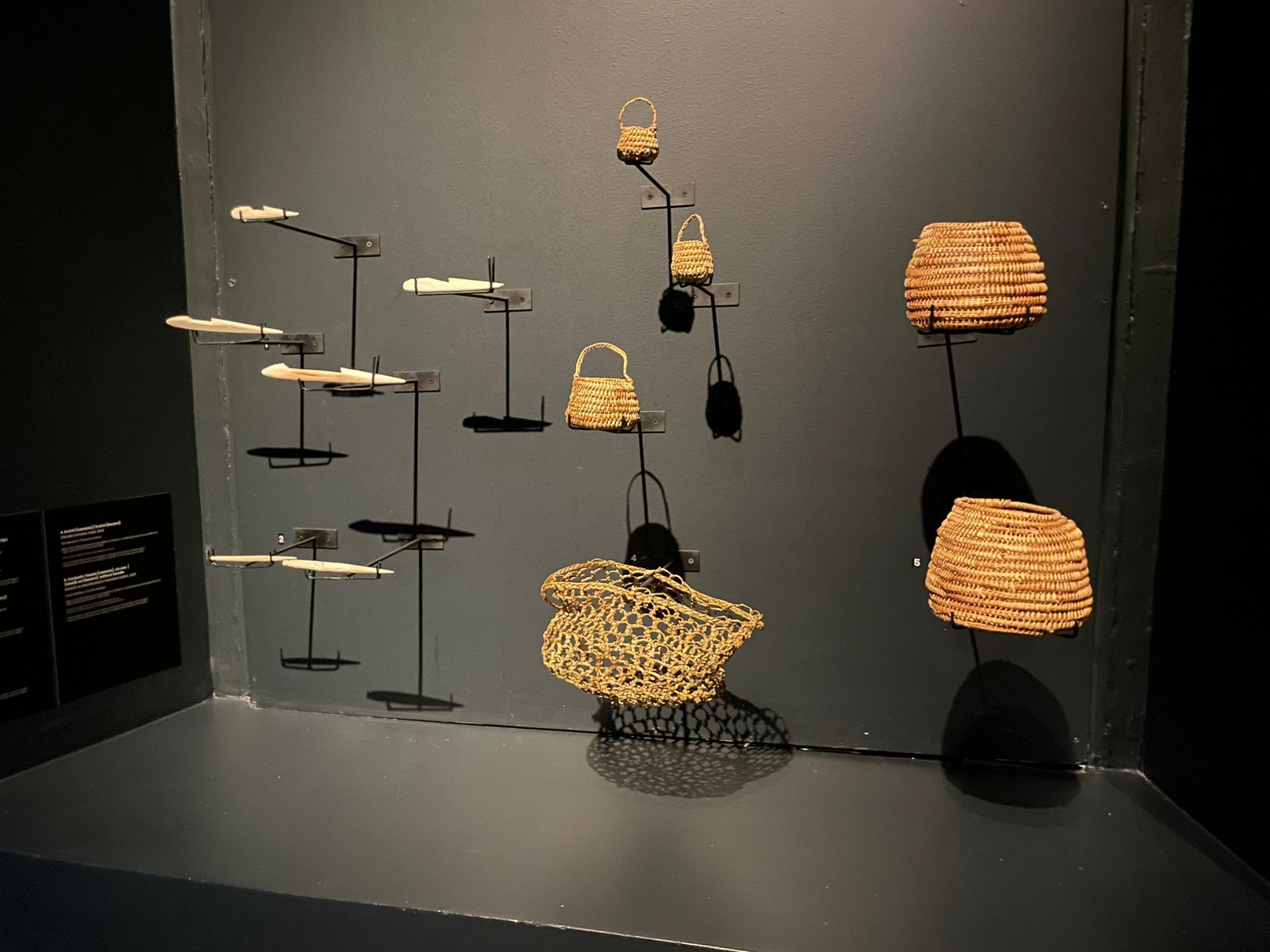
José's harpoons exhibited in Santiago, alongside woven rush basketry pieces made by his niece Claudia
A preview sale entirely to the benefit of the artisan
Karukinka transfers the entirety of the proceeds from this sale to José, with no deduction whatsoever for the association. This preview sale thus aims to directly support the transmission of his craft and the economic recognition of a unique piece of intangible cultural heritage.
Who this preview sale is intended for
The preview sale is open to:
Members of the Karukinka association, as a priority, in keeping with their closeness to the project and to José.
Enthusiasts of southern cultures and traditional navigation wishing to acquire an authentic handcrafted piece.
Museums and cultural institutions wishing to add to their collections a piece representative of Yagan maritime knowledge.
For any information request or reservation, interested parties may contact the association at contact@karukinka.eu or by phone at +33 6 72 83 03 94 (a first contact via WhatsApp is preferred until September 5) or at +33 2 40 56 31 95.
In 2023, Chile officially incorporated the Selk'nam people into Indigenous Law 19.253, nearly a century after the waves of mass violence that swept across Tierra del Fuego. Behind this legal reform lies a long process of memory work, advocacy, and cultural self-affirmation led by Selk'nam families themselves.
Table of content
A people long absent from indigenous law in Chile
Since 1993, Law 19.253 has recognised a list of "indigenous peoples or ethnicities" in Chile and established CONADI, the National Corporation for Indigenous Development. For thirty years, this list included the Mapuche, Aymara, Rapa Nui, Atacameño, Quechua, Colla, Diaguita, northern Chango people, Kawésqar and Yagán — but not the Selk'nam.
Yet the memory of Chilean Tierra del Fuego remains deeply shaped by the Selk'nam presence: a people of nomadic hunters whose world stretched across steppe, forests and shores. In the accounts of explorers, missionaries and travellers such as Darwin, this people appears on the margins, already caught up in forced displacement or extermination. In law, they vanished entirely: Chile built an indigenous policy without ever mentioning the descendants of this people of the Great Island.
From parliamentary motion to law 21.606
The path to recognition runs through a bill, registered as Boletín 12.862-17 in the Chamber of Deputies. Carried by a cross-party group of parliamentarians, it proposed a targeted amendment: the explicit inclusion of the Selk'nam people in Article 1 of Law 19.253. The process involved years of patient work in committees, hearings and technical redrafting.
In August 2023, the Senate debated the bill. Senators and senators emphasised the historical debt owed by the State — its responsibility for declaring this people "extinct" while their descendants were living in Tierra del Fuego, in Porvenir and across other cities in the country. They approved a version introducing the Selk'nam into Article 1 and updating the law's terminology by speaking of "peoples" rather than merely "ethnicities".
On 4 September 2023, the Chamber of Deputies adopted the bill at third reading. According to the official record, 117 deputies voted in favour, with a single abstention, and the text was definitively approved. The Selk'nam became the eleventh indigenous people recognised under the Indigenous Law and the third people officially recognised in the Magallanes Region, alongside the Kawésqar and the Yagán.
A recognition described as a "historical debt"
Once passed, the law was promulgated and published in the Official Gazette on 19 October 2023, as Law 21.606. The new wording of Article 1 now lists, after the other peoples, the Selk'nam among "the main indigenous peoples or ethnicities of Chile". In the text, the State affirms that it values the existence of these peoples as "an essential part of the roots of the Chilean Nation, as well as their integrity and development, in accordance with their customs and values".
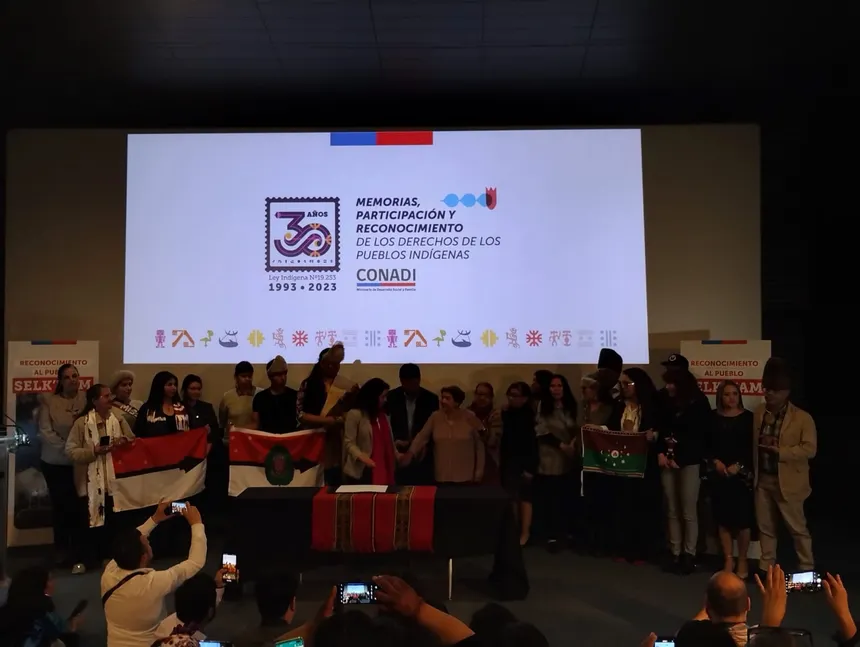
From the government's side, the Ministry of Social Development presented this reform as a form of reparation. Minister Javiera Toro spoke before Congress of a "historical debt" owed to the Selknam, recalling the State's responsibility in the policies that denied this people's existence and rendered their descendants invisible. On the occasion of the 30th anniversary of Law 19.253, CONADI chose to highlight this recognition as a "doubly historic" moment: the anniversary of the Indigenous Law, and the entry of the Selk'nam into the list of recognised peoples.
This institutional gesture is built on years of work by Selk'nam families. In Porvenir, the Covadonga Ona indigenous community — made up of Selk'nam descendants in Chilean territory — established the Corporación del Pueblo Selk'nam en Chile to represent the people on legal and political matters. Its mandate: defend collective rights, support legislative processes, and carry the voice of the families into spaces of negotiation with the State.
As early as 2019, the corporation submitted a bill specifically seeking to include the Selk'nam in Indigenous Law 19.253, with the support of indigenous legal scholars such as Ariel León Bacián. In parallel, other collectives — including the Telkacher community and the Fundación Hach Saye — were conducting fieldwork: language workshops, family research, and the reclaiming of narratives about the genocide and forced displacements.
A recent study, carried out in collaboration with the Fundación Hach Saye and the University of Chile, shows how these families mobilise law, art and ethnography to generate "new forms of struggle". Legal recognition becomes a lever for questioning access to ancestral territories, the restitution of indigenous place names in Tierra del Fuego, and the way Selk'nam history is taught in schools.
Selk'nam voices: between joy, caution and memory
In indigenous and allied media, the 2023 recognition is often described as "historic", but never as an endpoint. Servindi sums up the significance of the law by recalling that the Selk'nam become the eleventh indigenous people officially recognised by the Chilean State, after decades of official denial. This new visibility exists in dialogue with a history of violence: bounty hunts, forced displacements, confinement in missions and estancias, which marked the Great Island of Tierra del Fuego and the surrounding archipelago.
In an interview broadcast by El Mostrador and republished by Karukinka, young Selk'nam man Mauricio Astroza (Asamblea Telkacher) stresses the symbolic weight of this moment. For him, the legal recognition opens doors, but the challenge now is to defend a living culture, prevent the appropriation of Selk'nam symbols by institutions that do not work with the families themselves, and correct the notion — still present in some school textbooks — that the people has "disappeared".
At an official ceremony, the president of the Selk'nam Telkacher community, Ana María Muñoz, spoke of "mixed feelings": the joy of being recognised by the State and by Chile's other indigenous peoples, alongside the memory of generations who kept customs, stories and place names alive in a context of invisibilisation. The law has changed, but the work of reparation remains to be built, step by step, on the ground.
After recognition: what horizons?
Law 21.606 does more than add a name to a list. By updating the terminology of Law 19.253 towards "indigenous peoples", it brings Chilean law closer to the language of international instruments such as ILO Convention 169 and the United Nations Declaration on the Rights of Indigenous Peoples. This vocabulary opens the door to a more collective understanding of rights: political participation, territorial ties, protection of languages and knowledge.
Within this new framework, Selk'nam organisations are already advocating for concrete projects. In Tierra del Fuego, indigenous mapping projects for Selk'nam, Yagán and Haush territories explore how to rename landscapes using indigenous languages and historical pathways. A touring light artwork — Obra lumínica por el reconocimiento y la reparación del pueblo selknam — brings these questions of memory and justice to Porvenir and other southern cities, linking contemporary art, archives and family voices.
For the Selk'nam, the 2023 recognition thus marks a change of scale: from a people long described as "disappeared" in official discourse, to a living people, bearer of rights, knowledge and possible futures on their own land. For the Chilean State, it opens the obligation to build public policies in dialogue with these communities — not in their place.
Law 26.639, also know as Ley de Glaciares and enacted in 2010, established in Argentina the Minimum Budgets Regime for the Preservation of Glaciers and the Periglacial Environment, legally cementing the idea that glaciers are strategic freshwater reserves and public goods. Starting in 2025–2026, the national government pushed forward a project for a comprehensive modification of this norm (File 0161-PE-2025), which obtained half-sanction in the Senate and approval from the Chamber of Deputies, generating strong political and social conflict.
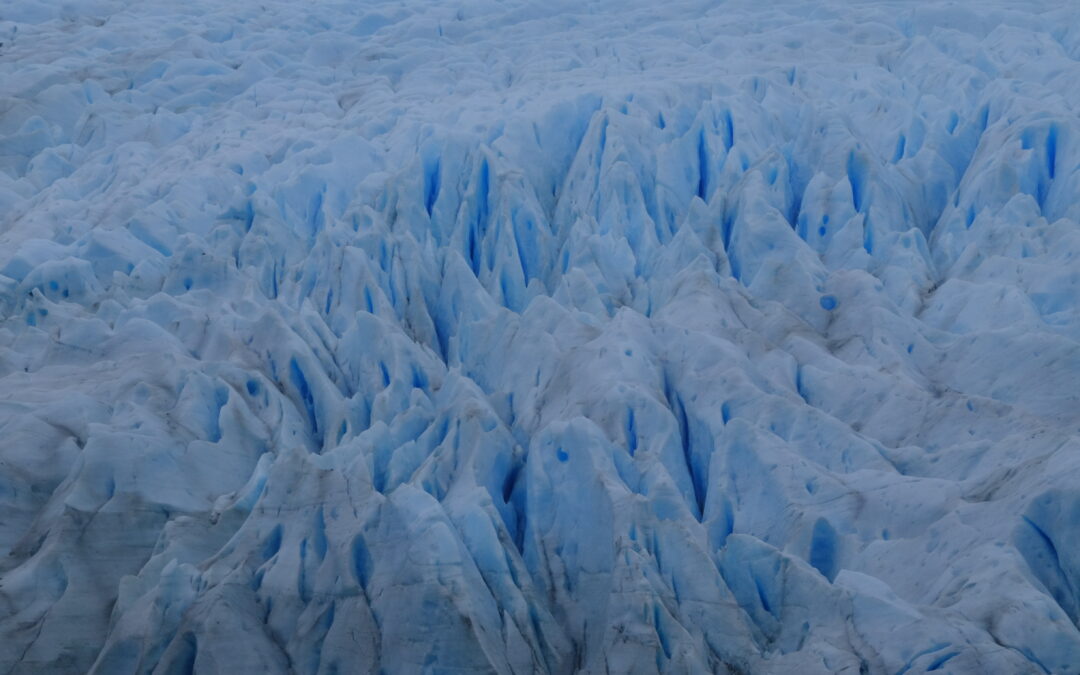
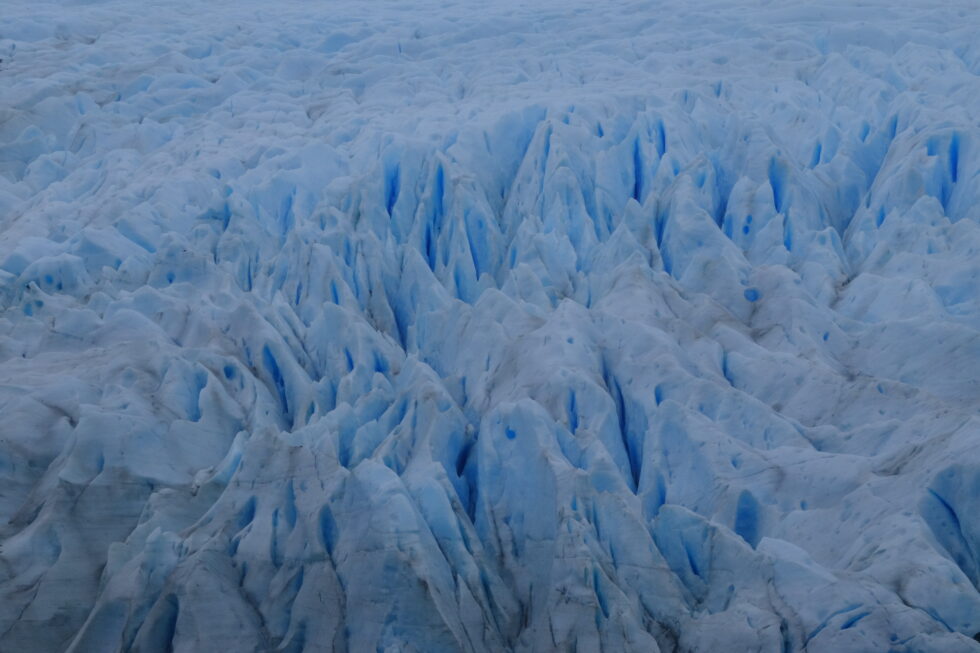
Karukinka Expedition (Fouque Glacier, 2025)
This article outlines the core content of the existing law, the main adopted modifications, the role of the provinces, as well as the social mobilizations and the interventions of Indigenous peoples—notably the Selk'nam jurist Antonela Guevara—who denounce the potential impacts of this reform (risks to water, ecosystems, and territorial rights).
Table of Contents
Law 26.639 (2010): content and scope
Purpose and principles
Article 1 of Law 26.639 sets the objective of establishing minimum budgets for the protection of glaciers and the periglacial environment, recognizing them as strategic reserves of water resources for human consumption, agriculture, watershed recharge, biodiversity protection, scientific research, and tourism. Glaciers are explicitly declared public goods.
The Library of Congress highlights that this law falls under the framework of Article 41 of the National Constitution (right to a healthy environment, national minimum budgets) and the General Environmental Law 25.675, which enshrines the principles of prevention, precaution, and non-regression.
Definitions: glacier and periglacial environment
Article 2 defines a glacier as any perennial ice mass, stable or slowly flowing, formed by the recrystallization of snow, regardless of its shape, dimension, or state of conservation; this includes rocky detrital materials and internal or superficial watercourses.
The periglacial environment is defined, in high mountains, as the area of frozen soils that acts as a water regulator, and in medium and low mountains, as the area with ice-saturated soils that plays the same regulatory role. These very broad definitions extend the scope of protection to forms of ice and frozen soils that go beyond just large visible glaciers.
National Glacier Inventory of Argentina (ING)
Articles 3 and 4 create the National Glacier Inventory, entrusted to the Argentine Institute of Nivology, Glaciology and Environmental Sciences (IANIGLA-CONICET), tasked with identifying all glaciers and periglacial landforms acting as water reserves, including their location, surface area, typology, and the variables necessary for their protection and monitoring.
The Legislative Dossier of the Library of Congress notes that Decree 207/2011 specified the organization of the ING by major glaciological regions (Desert, Central, Northern and Southern Patagonian Andes, Tierra del Fuego, and South Atlantic Islands) and mandated an update at least every five years.
Prohibited activities
Among its most important provisions, the law prohibits certain activities in glaciers and the periglacial environment, particularly:
mining and hydrocarbon exploration and exploitation;
the installation of industries;
the construction of works or infrastructure that could alter the natural dynamics of the ice or water quality (except for scientific research);
the storage or handling of contaminating or hazardous substances.
Any activity that may significantly affect these environments must be subject to a prior environmental impact assessment, in accordance with the General Environmental Law.
The 2025–2026 reform project: objectives and core modifications
Political context and stated objectives
In December 2025, the national executive branch submitted to the Senate Expediente 0161-PE-2025, aiming to amend Law 26.639, arguing the need to correct "interpretative flaws," lift legal uncertainties, and facilitate investments, particularly in mining. According to an analysis by Infobae, the executive presents the reform as a way to strengthen "environmental federalism" by giving provinces a greater role in managing their resources.
The project obtained 40 votes out of 72 in the Senate (40 in favor, 31 against, 1 abstention), with the support of part of the Radical Civic Union, Pro, and Peronist senators from mining provinces, before being passed to the Chamber of Deputies. In the lower house, the reform was ultimately approved by 137 votes in favor, 111 against, and 3 abstentions, and then sent to the executive for promulgation.
Redefinition of the inventory: "that act as reserves"
One of the most significant changes concerns Article 3 of the law, relating to the National Glacier Inventory. The new text, as described by the newspaper Ámbito, now stipulates that the ING will inventory glaciers and periglacial areas that "act as strategic reserves of water resources," instead of those that "fulfill the functions" of a reserve.
This substitution seems minor lexically, but the Library of Congress Dossier points out that it contributes to a re-definition of the extent of protected areas, by conditioning protection on the demonstration of an effective hydrological function rather than the mere presence of perennial ice. Provincial authorities are called upon to play a central role in this assessment.
Precautionary principle and possibility of subsequent exclusion
The reform introduces an Article 3 bis, which specifies, according to the text analyzed by Ámbito, that:
all glaciers and periglacial areas registered in the inventory will be considered part of the protected object until the competent authority verifies the non-existence of the hydrological functions defined in Article 1;
further on, it stipulates that when it is determined, based on technical-scientific studies, that a glacier or periglacial area "does not fulfill the intended functions," it may be considered excluded from the protected object.
We thus shift from a broad presumption of protection (any perennial ice mass in a periglacial environment) to a logic where the Inventory becomes a filtering tool, with the possibility of declassifying glacial units based on specific analyses.
Terminology: from "periglacial environment" to "periglacial landforms"
Several terminological modifications replace the expression "periglacial environment" with "periglacial landforms" (geoformas periglaciares) in the articles relating to the inventory and the competencies of authorities. For critics, this semantic substitution tends to fragment the object of protection (from the environment as a system to isolated landforms), which could reduce the territorial scope of the law.
Provincial competencies and the role of IANIGLA
The reform strengthens the mention of provincial authorities as "competent authorities," tasked with identifying, based on technical-scientific evidence, which glaciers and periglacial areas located in their territory fulfill certain hydrological functions. Where the previous version spoke of "sharing" information with IANIGLA, the new drafting replaces it with "notifying" the institute of the recorded ice bodies.
The Library of Congress Dossier indicates that these changes are at the heart of the debate on environmental non-regression: the fear is that provincial authorities subject to strong economic pressures might reclassify areas based on their hydrological functions, thereby reducing the extent of the protection regime.
Prohibited activities and environmental assessments
Article 6 (prohibited activities) is also amended. The new text maintains the catalog of prohibited activities (activities that "relevantly" alter the natural condition or hydrological functions, destruction, displacement, interference with ice advance, etc.), but now specifies that the severity of the alteration must be assessed "in the terms of Article 27 of the General Environmental Law 25.675," thus referring back to the environmental framework legislation.
The text confirms the obligation to subject any activity in glaciers and periglacial areas to environmental impact assessments, guaranteeing an instance of citizen participation in accordance with Articles 19 to 21 of the General Environmental Law. However, opponents argue that the reduction of the protected area makes these guarantees less effective.
Social mobilizations and territorial resistance
National mobilizations: "The Glacier Law is not to be touched"
The prospect of reforming Law 26.639 triggered a wave of mobilizations starting in late 2025, peaking during the debates in the Senate (February 2026) and the Chamber of Deputies (April 2026). Infobae and other Argentine media outlets reported massive demonstrations in Buenos Aires in front of the Congress, convened under the slogan "La Ley de Glaciares no se toca" ("The Glacier Law is not to be touched"), with a torchlight march and an artistic festival lasting until midnight.
Environmental organizations and citizen assemblies gathered for this day assert that the proposed changes endanger 7 million people and 36 watersheds deemed vital for various regions of the country, by opening the door to extractive activities in currently protected areas. Demonstrators insist that the reform "allows intervention in areas that the current law protects" and that it compromises access to water as a fundamental right.
Territorial mobilizations: the case of El Calafate
In El Calafate (Santa Cruz province), at the foot of the Perito Moreno glacier, mobilizations have followed one another: in February 2026, a new demonstration "in defense of the glaciers" was held simultaneously with the Senate vote, under the slogan "The Glacier Law is Not to Be Touched." According to local media Ahora Calafate, this was the fourth mobilization of the year 2026 in the city, with a march starting from Perito Moreno Square to the governor's official residence.
Organizers emphasize that "water and glaciers are non-negotiable" and announced further actions if the reform is approved, directly linking glacier protection to water security and the regional tourism development model.
Intervention of Indigenous peoples and the role of Antonela Guevara
A Selk'nam voice in the national debate
In this context, the jurist Antonela Guevara, lawyer for the Selk'nam community and a leading figure in the plurinational environmental campaign, became one of the most visible Indigenous voices in the debate over the Glacier Law. In an interview with Radio Provincia relayed by the media outlet Tarde pero Seguro, she stated that the modification of the law was decided "without social license and with a public hearing that was a farce," calling it "anti-regulatory" and "lacking real democracy."
Guevara denounces that more than 100,000 people who participated in the expanded consultation process were "silenced" and that the discussion is presented as purely technical, when "we are talking about water, about the present and future of life." She points out that the Selk'nam people have occupied the territory for over 10,000 years and asserts that the reform is intimately linked to commitments made by the government to the IMF and multinational corporations, rather than to the interest of citizens.
Glaciers, water, and prolonged genocide
In statements relayed on social media by Argentine Indigenous organizations, Antonela Guevara describes the modification of the law as a "new genocide" that threatens not only the glaciers but also the wetlands (humedales) and watersheds upon which Indigenous communities depend. She draws a connection between the current reform and local precedents, such as the salmon farming project in Tierra del Fuego, highlighting a similar logic of decisions made without genuine consultation and last-minute modifications.
Presenting herself as an "Indigenous woman and member of a people who have resisted for centuries," she insists that her participation in the national debate is not motivated by partisan affiliation, but by the defense of future generations, water, and ancestral territories.
Denounced potential impacts
Reduction of protected areas and risk of environmental regression
Analyses by the Library of Congress and Argentine economic media converge in stating that the reform "redefines the extent of protected spaces" by conditioning protection to glaciers and periglacial areas that demonstrate an effective hydrological function. This approach is perceived by many jurists and environmentalists as potentially regressive, contradicting the principle of non-regression enshrined in Argentine environmental doctrine.
Specifically, the fear is that small glaciers, buried ice zones, or frozen soils that play a water storage and regulation role—but are difficult to characterize—could be excluded from the specific regime, paving the way for mining, energy, or infrastructure projects.
Mining pressure and socio-environmental conflicts
Articles from La Nación and Infobae recall that one of the explicit goals of the reform is to "enable mining investments," particularly in copper and lithium, in areas hitherto considered protected by Law 26.639. The Andean provinces with a strong extractive focus (San Juan, Catamarca, Jujuy, Mendoza, etc.) occupy a central place in this debate, with some of their representatives having voted in favor of the reform in the Senate.
Mobilized organizations denounce that by weakening the perimeter of protected spaces, the reform risks intensifying existing socio-environmental conflicts surrounding large high-mountain mining projects, by reducing the legal instruments available to local communities and municipalities opposing them.
Threats to water and wetlands (humedales)
Actors in the "La Ley de Glaciares no se toca" campaign insist that the discussion is not just about visible ice, but the entire water cycle: aquifers, wetlands, catchments, and seasonal regulation. By limiting protection to glaciers and periglacial areas whose hydrological function is proven, the reform could, according to them, neglect complex hydrological systems whose contribution is not immediately quantifiable.
Antonela Guevara and other Indigenous spokespersons emphasize that these environments are intimately linked to the survival of their communities and their cosmologies, meaning that their alteration amounts to a new form of territorial and cultural violence.
CÁMARA DE DIPUTADOS DE LA NACIÓN ARGENTINA. Proyecto de modificación de la Ley 26.639: tratamiento parlamentario 2025–2026 [online]. Buenos Aires: HCDN, 2026 https://www.hcdn.gob.ar/
SENADO DE LA NACIÓN ARGENTINA. Dictamen y votación del proyecto de reforma de la Ley de Glaciares [online]. Buenos Aires: Senado de la Nación, 2026 https://www.senado.gob.ar/
TARDE PERO SEGURO. Antonela Guevara: “La modificación de la Ley de Glaciares se hizo sin licencia social” [online]. Argentina, April 8, 2026. https://tardeperoseguro.com.ar/?p=52515
ORIGINARIOS.AR. Antonela Guevara: intervenciones sobre la reforma de la Ley de Glaciares [online]. Argentine, s. d. https://originarios.ar/
Karukinka will be represented by three members: Mirtha Salamanca (Selk’nam community), José German González Calderón (Yagan community) and Lauriane Lemasson (co‑founder and scientific coordinator). The colloquium will take place at the University of Montpellier, providing a privileged scientific and institutional framework for the presentation of Karukinka’s field‑based toponymy program in southern Patagonia and Tierra del Fuego.
This participation places Karukinka at the heart of a reflection on inclusive toponymy – that is, on the role of place names in the recognition of Indigenous languages, identities, and territories. The association’s work in the channels and fjords of Patagonia has long combined nautical exploration, archival research, and oral history, with the aim of restoring and re‑circulating the original Indigenous toponyms of the region.
In Montpellier, this project will be presented as a concrete example of how toponymy, understood not only as a technical or administrative matter, but as a symbolic act, can contribute to understand better the geographic space and to rehabilitate part of the Indigenous memory. The presence of Mirtha Selk’nam Salamanca and José German González Calderón, as representatives of peoples whose languages and territories were long invisibilized or erased, will give special weight to these words.
Karukinka’s participation in this UNESCO‑framed colloquium also highlights the interdisciplinary and transnational dimensions of its program: links between geography, anthropology, linguistics, history, cartography, and environmental science. By bringing the Patagonian and Fuegian landscapes into the university amphitheater, the association contributes to bridging field work and academic discourse, and to making the southern natives worlds more visible in the international scientific landscape.
The colloquium will thus be an opportunity to share the association’s methodology of collecting, verifying, and restoring place names, as well as to discuss the ethical and practical challenges of working with Indigenous peoples and state institutions. These reflections are intended to support the re‑indigenization of the toponymy of Patagonia and the Cape Horn Biosphere Reserve, and, more broadly, to inspire similar initiatives in other regions where the Indigenous presence has been historically neglected.
In this way, attending the UNESCO Inclusive Toponymy Colloquium in Montpellier is not only a scientific and institutional event for Karukinka, but also a continuation of its long‑standing commitment to the memory and heritage of Indigenous peoples, and to the re‑reading of the map from the perspective of the communities who have lived there for millenias.
The genus Aphrastura (family Furnariidae) groups together small insectivorous passerines endemic to the southwestern part of South America. It historically comprises two species: the thorn‑tailed rayadito (Aphrastura spinicauda, synallaxis rayadito or espinoso rayadito), widely distributed in the temperate forests of Chile and southern Argentina, and the Masafuera rayadito (Aphrastura masafuerae), microendemic to Alejandro Selkirk Island in the Juan Fernández Archipelago.
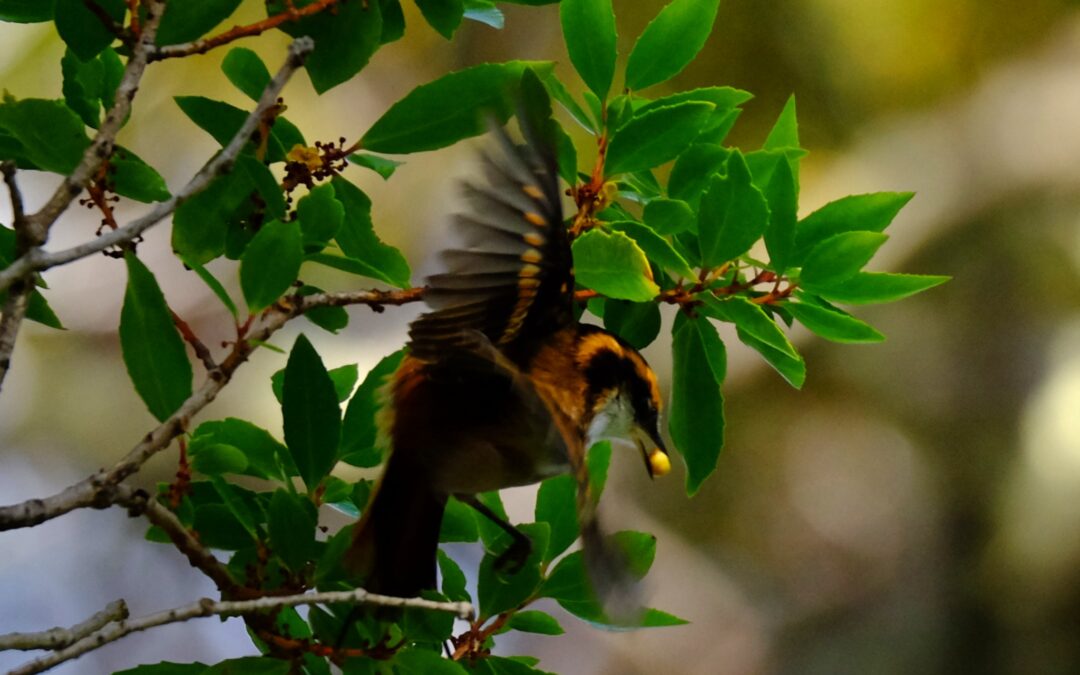
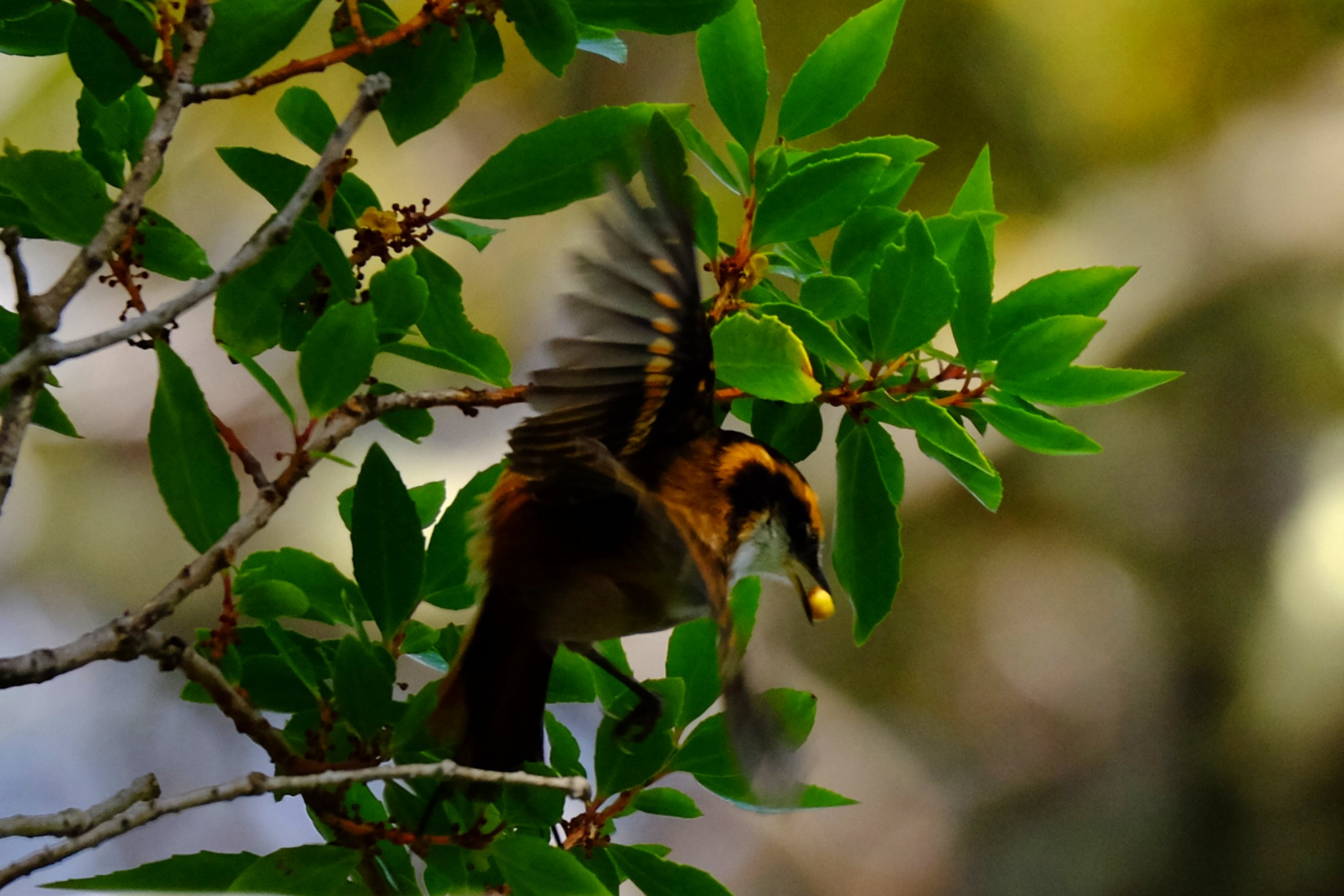
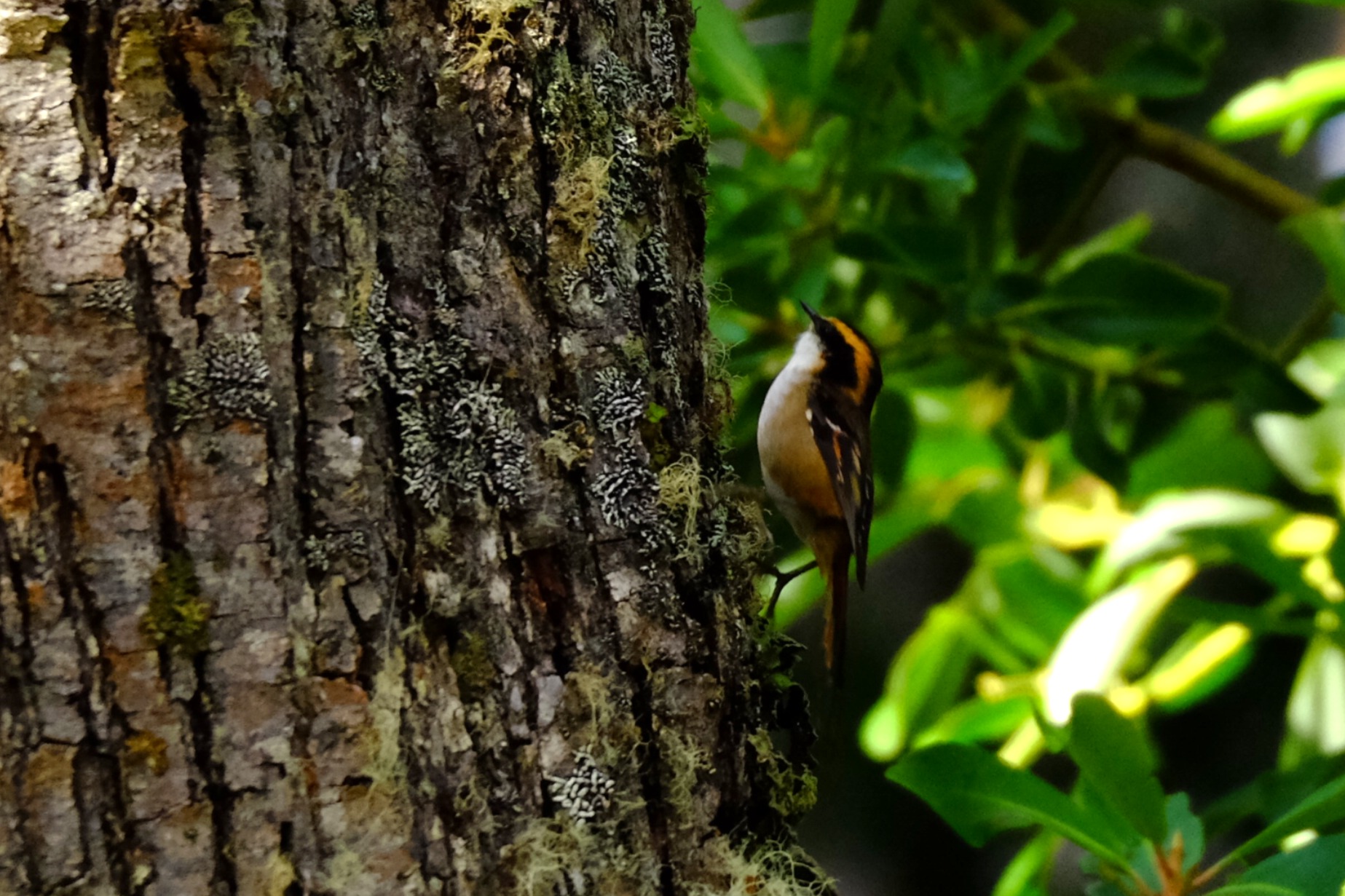
Rayadito (Aphrastura spinicauda) photographed during a Karukinka expedition in the channels of the Cape Horn Biosphere Reserve (Chile, April 2025).
The rayaditos (in Yagán: tachikatchina) play a central role in the biology of southern temperate forests, where A. spinicauda is one of the most abundant tree‑cavity birds (and one of the most vocal!) in the Nothofagus forests, up to the southernmost limits of the Cape Horn Biosphere Reserve.
Within this subantarctic context, the recent discovery of the subantarctic rayadito (Aphrastura subantarctica) in the Diego Ramírez archipelago, to the southwest of Cape Horn, has revealed a remarkable case of island diversification within a treeless environment.
Table of contents
Distribution, diversity and ecosystems
Recent studies on the community of cavity‑using birds show that A. spinicauda is one of the most abundant passerines in southern temperate forests, with densities exceeding 9 individuals per hectare and a strong dependence on cavities excavated by the Magellanic woodpecker (Campephilus magellanicus). In contrast, A. subantarctica inhabits an herbaceous archipelago dominated by Poa flabellata and uses ground cavities or the structures of seabird nests for breeding, in the absence of terrestrial mammalian predators.
Morphology, ecology and behaviour
A. spinicauda is a small passerine of about 12 g, with a long, slender tail employed in its acrobatic movements on trunks and branches. Its streaked, brown‑reddish plumage provides excellent camouflage against bark and foliage, and it feeds primarily on insects and larvae, exploring bark and understory vegetation.
A. subantarctica, on the other hand, averages 16 g, with a longer bill, heavier legs, a shorter tail and a behaviour focused close to the ground, reflecting adaptation to a wind‑exposed, herbaceous habitat.
The behaviour of the rayadito in Yagán territory is illustrated by these words from Ursula Calderon: “Tachikatchina is a bird that sings in the mountains during the day, warning that someone is hidden: a wicked man, a sorcerer. It thus announces to the walker the presence of these people, or of a dog, of a cat… in short, of someone hidden. Its calls, when they sing together, are frightening, tsch‑tsch‑tsch, since they do not announce anything good” (p. 70, réf. 10).
Rayadito or Tachikatchina, photographed in April 2025 in Caleta Borracho (sailing expedition through the Patagonian channels, Chile).
Genetics, speciation and conservation
Genetic analyses show a clear differentiation between A. spinicauda and A. subantarctica, which justifies proposing A. subantarctica as a new emblematic species of subantarctic biodiversity. This distinction, combined with morphological and behavioural differences, places the Diego Ramírez archipelago as a natural laboratory of speciation and conservation, now protected by the Diego Ramírez–Drake Passage Marine Park.
For A. spinicauda, the conservation of old‑growth, cavity‑rich forests and the preservation of the Magellanic woodpecker population are essential to maintain the structure of rayadito populations within the Cape Horn Biosphere Reserve.
Sources :
Rozzi, R. et al. (2022). “The Subantarctic Rayadito (Aphrastura subantarctica), a new bird species on the southernmost islands of the Americas”. Scientific Reports 12, 13957. https://doi.org/10.1038/s41598-022-17985-4
Rozzi, R. et al. (2023). “The subantarctic rayadito (Aphrastura subantarctica), a new bird species on the southernmost islands of the Americas (repositorio UChile version)”. Repositorio UChile. https://repositorio.uchile.cl/handle/2250/194760
Ramírez‑D’Crego, R. (2022). “The Subantarctic Rayadito (Aphrastura subantarctica), a new bird species on the southernmost islands of the Americas”. CECS research‑related article. https://ramirodcrego.com/papers/article29/
Zenodo (2022). Dataset “The Subantarctic Rayadito (Aphrastura subantarctica), a new bird species on the southernmost islands of the Americas”. Morphological and genetic data. https://zenodo.org/records/6983420
Rozzi, R. et al. (2022). “The Subantarctic Rayadito (Aphrastura subantarctica), a new bird species on the southernmost islands of the Americas”. PMC version (NIH‑NIHMS). https://pmc.ncbi.nlm.nih.gov/articles/PMC9418250/
Rozzi, R. et al. (2022). Taxonomic description of Aphrastura subantarctica (Wikispecies).
Marine, R. H. et al. (2022). “The extreme rainfall gradient of the Cape Horn Biosphere Reserve”. Science of the Total Environment ou équivalent (étude de biodiversité et de rayaditos dans les canaux).
Rozzi, R. et al. (2018). “Marine biodiversity at the end of the world: Cape Horn and Diego Ramírez islands”. PLOS ONE ou revue équivalente, décrivant la diversité des îles Diego Ramírez et la contexte écologique.
Rozzi, R. et al. (2017). "Guia Multi-Etnica de Aves de los Bosques Subantarticos de Sudamérica". Ediciones Universidad de Magallanes.
Today we share with you a Yagan story dedicated to the hummingbird, told by Úrsula Calderón and Cristina Calderón in 2001 in Mejillones Bay (Navarino Island, Chile). It was published on pages 170 and 171 of the book Guia Multi-Etnica de Aves de los bosques subantárticos de Sudamérica (2017) and translated from Spanish to English by the Karukinka association.
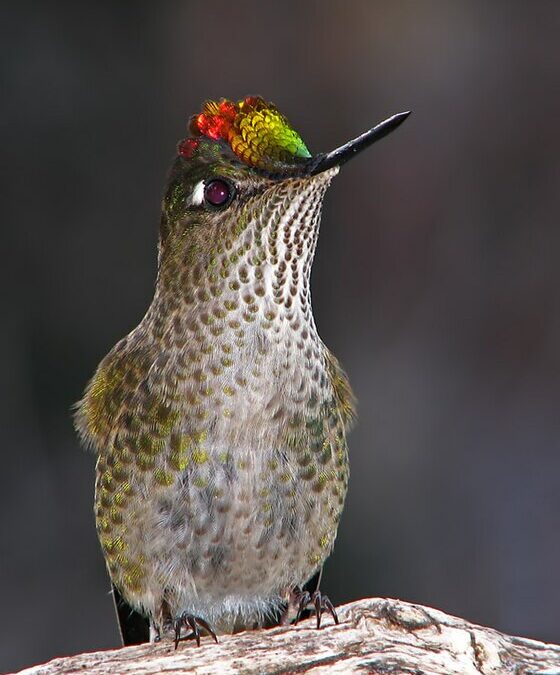
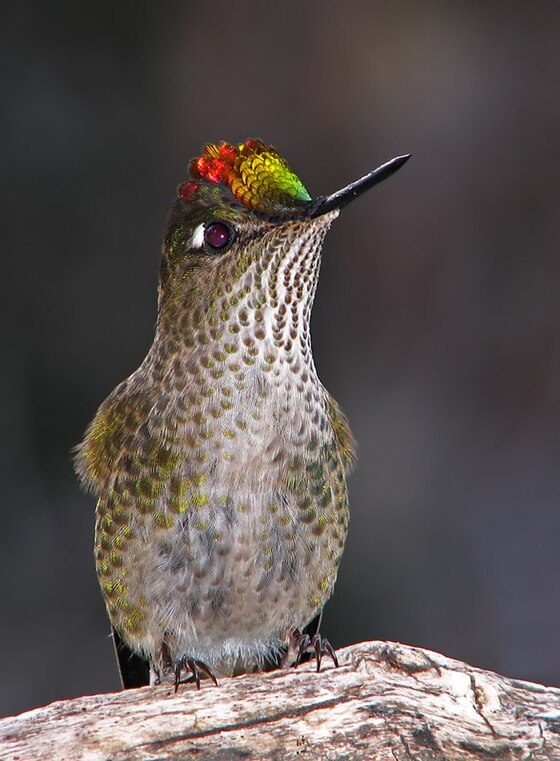
The Chilean hummingbird Sephanoides sephaniodes
The Yagan story of the hummingbird
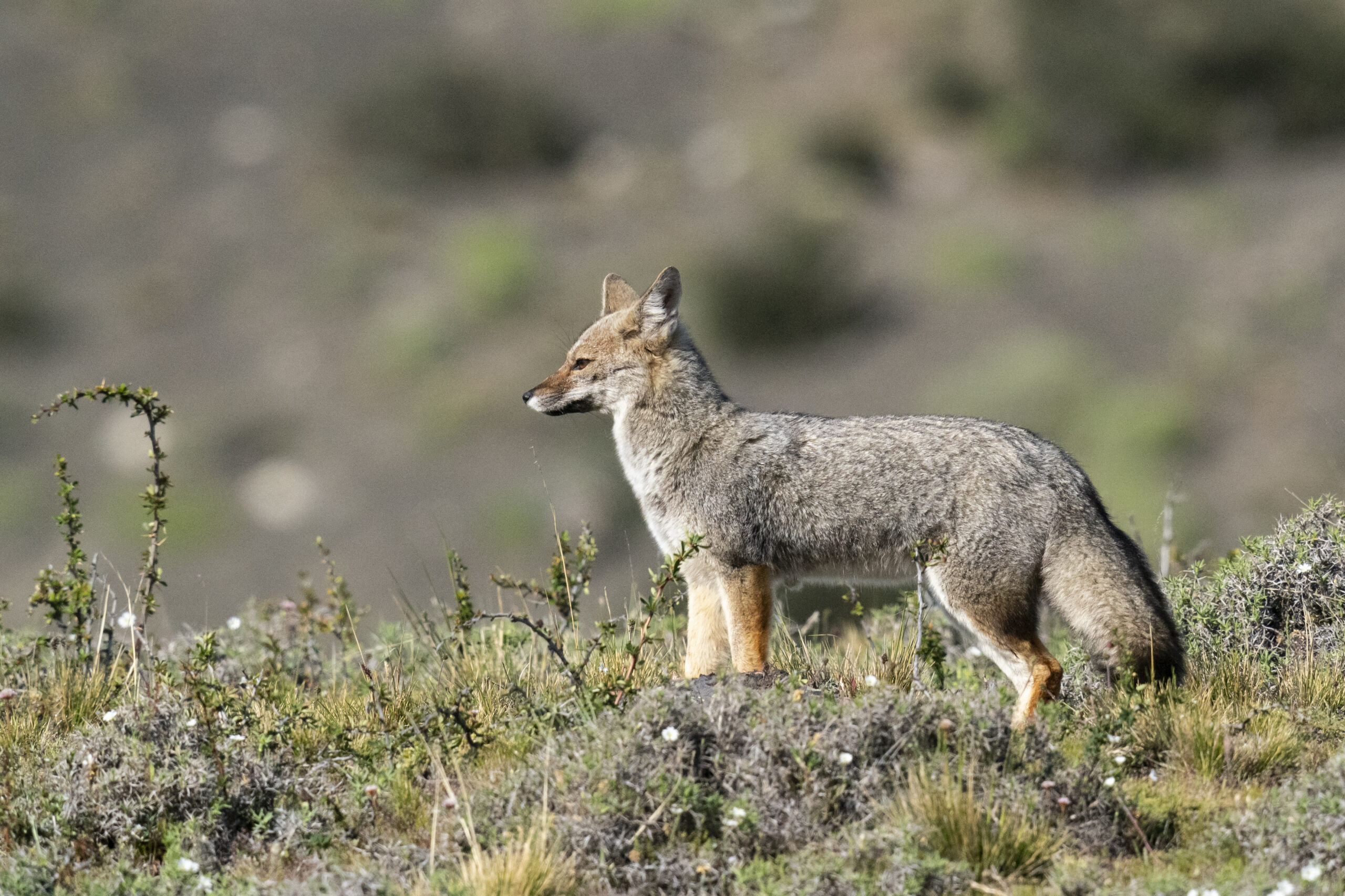
“Once, when birds were still humans, a severe drought struck the Cape Horn region and its inhabitants were dying of thirst. The cunning fox (cilawáia, the Magellan fox) found a lagoon and, without telling anyone, built a fence around it with umush branches (calafate in Yagan) so that no one could enter. Hidden there, he drank plenty of water alone, only caring for himself.
After some time, others discovered the lagoon's existence and, as a group, they went to ask cilawáia for some water. But he didn’t even want to listen to their pleas and brusquely expelled them. The people's condition worsened by the moment, and in their despair, they remembered omora. They sent a message to this small occasional visitor who, in similar past shortages, had saved their lives.
The Magellanic fox (Lycalopex griseus, cilawáia)
The hummingbird, or little omora, was always ready to help and came very quickly. Although weakened, this tiny creature (human or spirit) is braver and more fearless than any giant. Upon arrival, people told him in detail what had happened about the great shortages. Omora, upon hearing what happened, became indignant and flew to the place where cilawáia was. Selfish, the fox confronted him. And omora said: ‘Listen! Is it true what others told me? You have access to a lagoon, and you refuse to share your water with others. Do you know that if you don't give them water, they will die of thirst?’ The fox replied: ‘What do I care? This lagoon has very little water, just enough for me and some close relatives.’
Hearing this, omora became furious and, without answering cilawáia, he returned to the camp.
He thought hard and, hastily, rose holding his staff and returned to where cilawáia was. On the way, omora collected several sharp stones, and when close enough to the fox, he shouted: ‘Will you finally share the water with everyone?’ The selfish cilawáia answered: ‘Let them die of thirst. I can’t give water to each one of them, or else my family and I will starve.’
Omora was so furious he could not restrain himself and leapt with his staff, killing the fox with the first blow.
The others watching came running happily to the place, broke the fence, approached the lagoon, and began to drink to quench their thirst — all of the water. Some birds who arrived late barely managed to wet their throats. Then, the wise little owl sirra (grandmother of omora) said to the birds who had arrived late: ‘Go collect mud from the bottom of the lagoon and fly to the tops of the mountains, above which you must sprinkle.’
The little birds and their balls of mud created vertical springs that originated the watercourses cascading from the mountains, forming small streams and large rivers running through ravines. When everyone saw this, they were extremely happy and all drank large amounts of fresh and pure water, which was much better than the lagoon water that the selfish cilawáia guarded. Now everyone was saved. To this day, all these watercourses flow from the mountains and provide exquisite water. Since then, no one should die of thirst.”