The study proposes a collaboration model between ancestral Mapuche knowledge and ecological science, demonstrating that nature conservation requires listening to, respecting, and working alongside indigenous communities.
Temuco, October 23, 2025. (diariomapuche.cl) – A study published by the scientific journal Ecology & Evolution highlights the contribution of the Mapuche people to the understanding and protection of biodiversity in southern Chile. The research, titled "Listening Deeply to Indigenous People: A Collaborative Perspective and Reflection Between a Mapuche Machi and Ecologists", proposes a paradigm shift in ecological science: moving from consulting communities to co-producing knowledge alongside them.
The work was developed by a group of scientists and a machi from the Conguillío territory, who shared knowledge, experiences, and reflections on the impacts of industrial projects—forestry and hydroelectric—on the Truful-Truful river basin, one of the ecosystems most affected by extractivism in Wallmapu.
"The machi and the ecologists show us that listening deeply to indigenous peoples is not a symbolic act, but a condition for understanding the life of the territory," the study states.
Ancestral Mapuche knowledge and science with two eyes
The team applied the "Two-Eyed Seeing" approach, a framework that integrates Western scientific vision with Mapuche cosmovision. In this way, two ways of knowing the world are articulated: one based on ecological data and another on the spiritual and territorial experience that sustains the Mapuche relationship with itrofil mongen (biodiversity).
The article identifies historical barriers between academia and indigenous peoples—such as mistrust, knowledge extractivism, and inequality in decision-making—but also shows concrete paths for collaboration, respect, and reciprocity.
The territory speaks
The research documents how exotic plantations and hydroelectric projects have altered medicinal species, water courses, and cultural practices linked to küme mongen (good living). Against this, the study proposes that indigenous communities participate as co-managers and co-researchers, recognizing their territorial and spiritual authority over the ecosystems they inhabit.
The publication concludes that without indigenous peoples there will be no effective nature conservation, and that integrating their knowledge and rights into public policy is an urgent task in the face of the global climate crisis.
"Wallmapu does not only conserve biodiversity: it conserves memory, language, and spirituality. Listening deeply to its inhabitants is also listening to the earth," the statement summarizes.
The Pacification of Araucania: a comprehensive analysis of invasion, dispossession, and Mapuche genocide
Chile's history contains a chapter written with euphemisms and blood: the misnamed "Pacification of Araucania." This article delves into the details of this process (1861-1883), deconstructing the official narrative to reveal a complex operation of military conquest, legal dispossession, and forced colonization that redefined the destiny of the Chilean state and the Mapuche people, leaving a legacy of conflict that persists to this day.
1. Historical context: autonomous Wallmapu and the expansionist Chilean state
In the mid-nineteenth century, the southern frontier of Chile was clearly delineated by the Biobío River. South of it extended Wallmapu, the ancestral territory of the Mapuche people, a de facto independent nation that had resisted Spanish conquest for more than 300 years. Mapuche society was organized into a complex social and political structure based on the lof (family clan), the ayllarewe (federation of lofs), and the butalmapus (large territorial alliances).
For the Chilean state, consolidated after the wars of independence and under the influence of European ideas of progress, this autonomy was a problem. Political and economic elites, under the presidencies of Manuel Montt (1851-1861) and then José Joaquín Pérez (1861-1871), viewed occupation as necessary to:
Appropriate resources: the lands of Araucania were considered the "granary of Chile."
Unify territory: connect the central zone to colonies in Valdivia and Llanquihue.
Assert sovereignty: eliminate the internal frontier and project an image of a modern nation.
2. Key actors in the conflict
This historical process was led by figures and groups with radically opposed interests.
Category
Main Actors
Role in the Conflict
Chilean State (Officials)
José Joaquín Pérez, Federico Errázuriz Z., Aníbal Pinto, Domingo Santa María
Presidents who drove the occupation policy
Chilean State (Military)
Col. Cornelio Saavedra, Gen. Gregorio Urrutia, Col. Basilio Urrutia
Chilean and European settlers, Orélie Antoine de Tounens
Occupied lands, pretext for conquest
3. The State's plan: Cornelio Saavedra's proposal
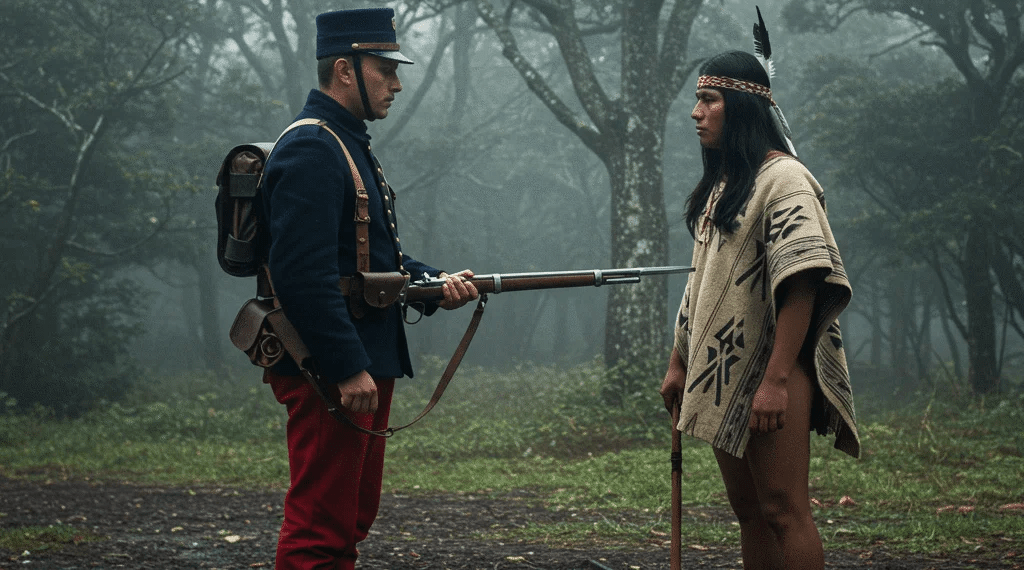
In 1861, Colonel Cornelio Saavedra Rodríguez presented to the Chilean Congress a detailed plan for the "Pacification of Araucania." He proposed abandoning the policy of treaties for material occupation, based on three axes:
Advance the military frontier from the Biobío to the Malleco, with forts.
Subdivide and sell "secured" lands.
Promote the settlement of Chilean and foreign settlers to "Chilenize" the region.
The plan sparked debate but was approved by Congress, triggering the invasion.
4. Military execution: phases of an asymmetric war
Military conquest unfolded in several phases, interrupted by Mapuche uprisings and the War of the Pacific.
First Phase (1861-1868): Advance and Fortification Foundation of forts (Angol, Mulchén, etc.), immediate Mapuche resistance, "scorched earth" tactics applied by the army.
Second Phase (1869-1881): Diplomatic Pause and Consolidation Slowdown in advance, territorial consolidation, introduction of telegraph and railroad.
Third Phase (1881-1883): The Final Offensive Last major Mapuche uprising in 1881, massive military repression, founding of Temuco, military end of the "Pacification."
5. Legal dispossession: how laws annihilated Mapuche property
Military conquest was inseparable from legal conquest.
Radicación Law of 1866:
Definition of "vacant lands": any land not "continuously occupied" by indigenous peoples becomes state property.
Imposition of individual private property, foreign to Mapuche culture.
Creation of radicación commissions, a process rife with abuses and corruption.
"Títulos de Merced": Confinement in Reductions
Attribution of small portions of land (approximately 6 hectares per person), insufficient for traditional economy.
Loss of over 90% of Mapuche territory.
Social fragmentation and isolation of communities.
6. Directed colonization: land for some, dispossession for others
Treatment of the Mapuche People: confinement in reductions, lack of state support, status of "minors" under guardianship.
Treatment of European/Chilean Settlers: large parcels, state support (travel, tools, animals, medical assistance), status as full citizens.
7. The human catastrophe and the genocide debate
The "Pacification" was a human catastrophe that decimated the Mapuche population, fueling a debate about the term "genocide" according to the UN definition (1948).
Destruction of economy, dispossession of land, confinement in uninhabitable zones, massive famines and epidemics.
Ethnocide: destruction of culture through prohibition of language, religion, and autonomous education.
Historiographical Perspectives
Traditional: inevitable process for Chilean unification.
Revisionist: imperialist conquest, systematic violence, labeled ethnocide or genocide.
Mapuche: invasion of a sovereign country, beginning of a persistent colonial relationship.
Demographic Collapse
Between 20,000 and 30,000 Mapuche died of hunger and disease between 1881 and the early twentieth century.
The Mapuche population, estimated at half a million before conquest, suffered a demographic collapse from which it did not recover for more than a century.
8. Total impact: disarticulation of Mapuche society
The "Pacification" caused a structural rupture in all aspects of Mapuche life:
Political: loss of authority of the lonkos.
Economic: transition from a prosperous society to poverty.
Social: fragmentation and forced migration to cities.
Cultural: forced assimilation, threat to Mapuche language and worldview.
9. Mapuche resistance and resilience
Despite devastating circumstances, Mapuche resistance endured, transforming into political and legal struggles in the twentieth century. Memory and cultural identity survived clandestinely, testifying to remarkable resilience.
10. Legacy and historical debt: roots of current conflict
The "Pacification of Araucania" is the direct source of current conflict in Chile. The territorial and autonomy claims of the Mapuche movement rest on this historical dispossession. The "historical debt" is central to public debate, and recommendations for reparation remain largely unimplemented.
11. Comparative analysis: Araucania, the Argentine "Desert," and the American West
The Chilean process was not isolated:
Conquest of the Desert (Argentina, 1878-1885): similar ideological justification, total war tactics, objective of freeing lands for livestock.
Indian Wars (United States, nineteenth century): westward expansion, reservations, similar dispossession and violence.
In all cases, nation-states used their military superiority and a legal framework to dispossess indigenous peoples, leaving a legacy of trauma and struggle for justice.
Conclusion: a history to reclaim
The "Pacification of Araucania" was a war of conquest that dispossessed a people of their territory and sought to annihilate their culture. Understanding it in all its complexity is a duty for any society aspiring to justice. Recognizing this past is not reopening wounds, but beginning to heal them on the basis of truth and reparation.
On the occasion of the Green Shift Festival, held from 5th to 7th June in Monaco, Jorge Quilaqueo, a Mapuche Chaman, exchanged with Sabah Rahmani, an anthropologist journalist, and Hélène Collongues, anthropologist specialising in the Jivaro people.
On the stage of the Green Shift Festival, from left to right, Jorge Quilaqueo, Sabah Rahmani, Hélène Collongues and Sébastien Uscher (the mediator). Credited by Philippe Fitte / FPA2
Jorge Quilaqueo is a Mapuche Chaman. This autochthonous people from Chile and Argentina once occupied a large part of the territory around the Andes Cordillera, until the arrival of the Spanish, from the Pacific Ocean to the Atlantic Ocean. Jorge Quilaqueo defends the rights of his people, dispossessed of a large part of their lands and wiped out gradually through the ages – there would be less than one million Mapuches today.
He is working at inciting all the people to reconnect to the living.
When stopping in Europe, he opened the 2024 Green Shift Festival of Monaco on 5th June with a water ceremony. This event was dedicated to new utopias of a more sustainable world and was the opportunity to talk about « the ecology of the emotional rather than the rational », as explained by Olivier Wenden, vice-president of the Prince Albert II of Monaco Foundation, who’s organising the festival, and of which WE DEMAIN is a collaborator.