Cercophana frauenfeldii Felder, 1862 (Lepidoptera: Saturniidae): Taxonomy, Ecology and Presence in the Far South of Chile

Karukinka
1 May 2026

Association Karukinka
Law 1901 - of General Interest
Latest news


Follow us
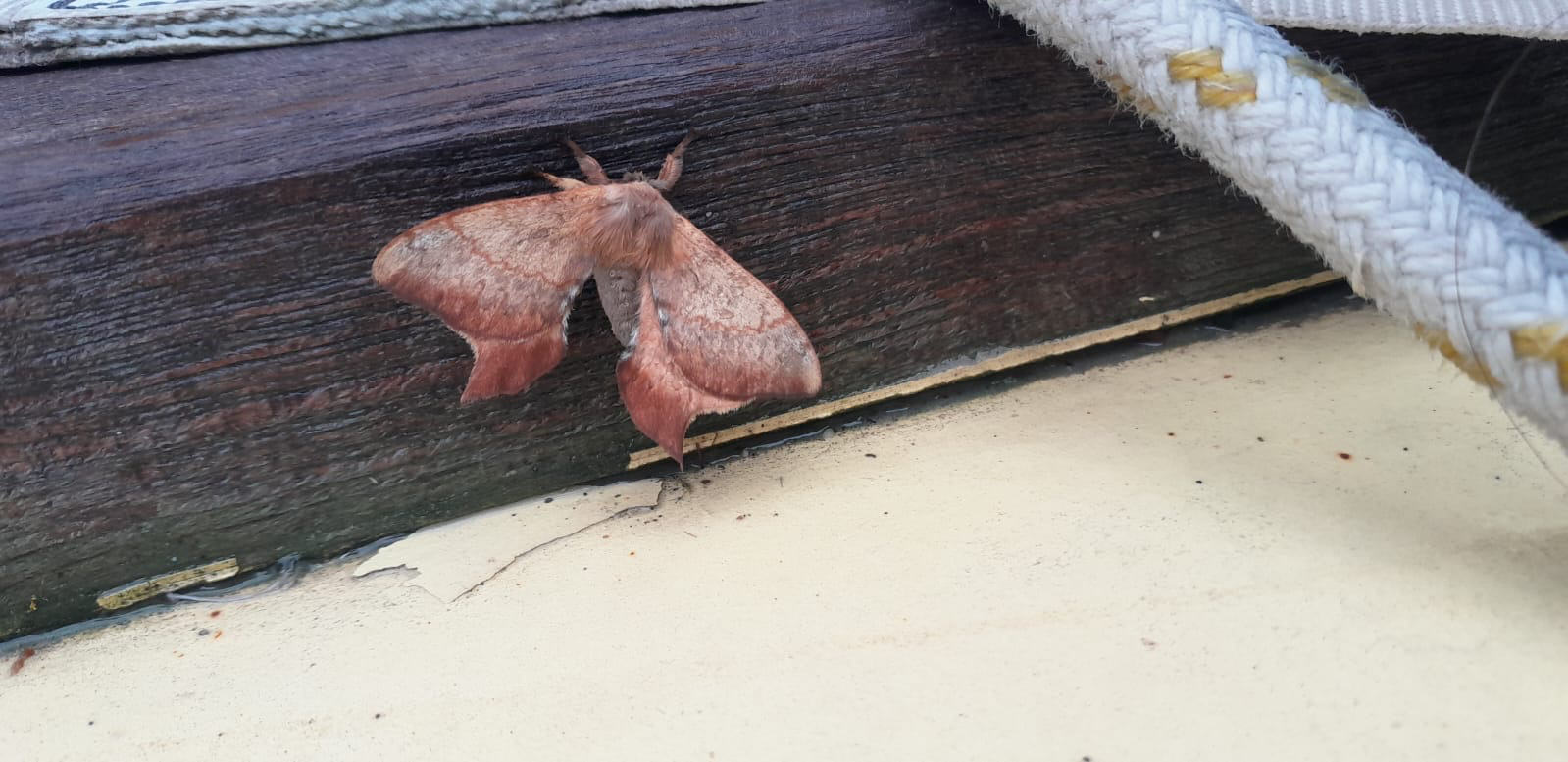
Once is not always the norm aboard the sailing vessel Milagro — and following Callisphyris leptopus Philippi: in mid-April 2026, with Ben, Milena, Gabriel, Damien and Lauriane, as we were leaving one of the arms of Bahía Tres Brazos, a bay located to the north-west of Gordon Island, we received a new visitor that would give us quite a headache: an adult male Cercophana frauenfeldii.
We will not hide from you that identifying this species was no easy feat — friends and acquaintances alike were all astonished by our photographs. After checking the GBIF database, we found that our observation appears to be among the southernmost research‑grade records of Cercophana frauenfeldii currently available there. This underlines how integrating opportunistic observations into open platforms such as iNaturalist and GBIF can complement existing Chilean work by documenting species in remote places where access and sampling are logistically demanding.
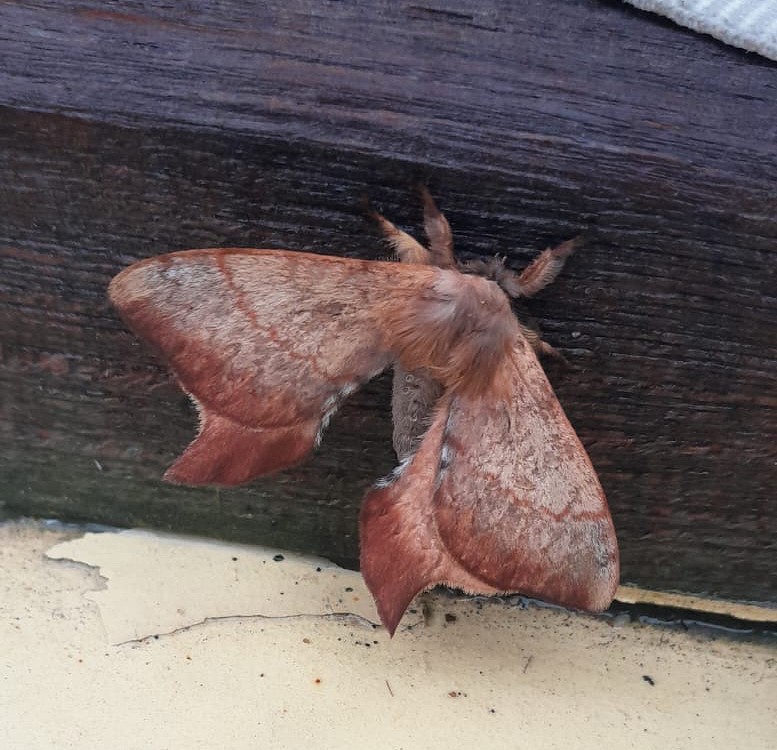
Here a detailed spotlight on an uncommonly encountered nocturnal visitor in these waters!
Table of Content
Introduction
Cercophana frauenfeldii Felder, 1862 is a large Neotropical Saturniidae endemic to Chile, also known by the English common name "Andean Moon Moth" on account of its Andean range and its resemblance to a "lunar sphinx". Over the last decades, Chilean and South American entomologists have provided key information on the taxonomy, life cycle and host plants of C. frauenfeldii, from its northern range to Magallanes. Recent work has clarified the immature stages, phenology and host associations, laying the groundwork for interpreting new records such as ours.
In the second half of the 20th century, C. frauenfeldii was incorporated into syntheses on the Chilean Saturniidae fauna, particularly in revisional works on the family and the genera Cercophana and Neocercophana. More recent studies (2021) have complemented these approaches by describing the immature stages (egg, larva, caterpillar, cocoon…), the phenology, the species' distribution and its host plants.
Taxonomy, Morphological Characters and Developmental Stages
1. Original Description and Nomenclatural Status
The species was described by Felder in 1862 under the name Cercophana frauenfeldi, based on material from continental Chile, making it one of the first South American Saturniidae to be formally described. Modern catalogues of the Saturniidae family in Chile confirm this status, retaining the spelling frauenfeldii (with a double "i") as valid and placing it in the genus Cercophana Felder, 1862.
Revisions of the family in South America recognise Cercophana as a small Andean genus restricted to Chile, grouping C. frauenfeldii and a few closely related species including Cercophana venusta, distinct from the neighbouring genus Neocercophana described later for related taxa. Regional catalogues of Argentine Saturniidae also list this species as an element of the trans-border Andean fauna.
2. General Morphological Characters
Works on Chilean Saturniidae describe Cercophana frauenfeldii as a large nocturnal moth with broadly developed wings, varying from brown-ochre to greenish in colour, with lighter patterns and variable transparent or hyaline markings. In adults, sexual dimorphism is expressed through strongly bipectinate antennae in the male, adapted for pheromone detection, while females typically have a more voluminous abdomen associated with egg production.
A recent article in the Brazilian Journal of Entomology, dedicated to the immature stages, describes in detail the egg, the four larval stages, the pupa and the cocoon, providing a complete morphological basis for identification at all stages of development.
3. Immature Stages and Development
The detailed study of the immature stages of Cercophana frauenfeldii shows that larval development comprises four well-differentiated instars, generally spanning from November to late January throughout most of the species' range. The caterpillars feed on the leaves of their host plants, displaying primarily nocturnal activity and concealing themselves among foliage during the day.
Pupation occurs within a silken cocoon whose structure and location may vary depending on habitat conditions, but which is generally situated in the leaf litter or on low-hanging branches.
Geographical Distribution in Chile
1. Latitudinal Gradient and Biogeographical Provinces
Chilean catalogues and syntheses record Cercophana frauenfeldii from the centre of the country to the humid temperate regions of the south, particularly in the Maule, Biobío, La Araucanía, Los Lagos and Aysén regions. A recent compilation of field data and naturalist collections confirms that the species follows an Andean-coastal gradient associated with temperate forests.
TA synthesis of published records and naturalist collections suggests two broad phenological and biogeographical groupings: the northern group, where adults fly mainly from February to mid-April, and the southern group (temperate rainforests), where the main flight period shifts to between April and June (the case of our visitor).
2. Southward Extension and the Magallanes Region
Works specifically addressing the Magallanes region highlight that C. frauenfeldii reaches the southern part of continental Chile, where it remains more localised. An article focused on the host plants of this moth confirms the presence of populations in temperate forests close to the southern limit of distribution of the host tree species, primarily belonging to three families: Gomortegaceae, Lauraceae and Winteraceae. The plants most represented in the studies conducted are Cryptocarya alba, Beilschmiedia miersii, Gomortega keule and Persea americana, all of which develop further north than our visitor.
While published records are concentrated mainly at sites further north than the Chilean Antarctic province where we explore, records from the Magallanes region make the species' presence in sub-Antarctic archipelagos plausible. According to observations made in 2003 in Parque Omora (Puerto Williams), this moth also uses the canelo or Magellan pepper (Drimys winteri) as a host plant, and this tree is ubiquitous in the Province of Cabo de Hornos.
The most recent works stress the need to better document the fine-scale distribution, phenotypic variability and population genetics of Cercophana frauenfeldii from the north-central to the far south of Chile.
Scientific Significance of This Local Record
Although this record has not yet been incorporated into Chilean academic syntheses, it is fully consistent with the documented distribution of C. frauenfeldii as far south as Magallanes and with the continuity of native forests in the region. Rather than revealing a major range extension, the observation adds a documented island locality within the Cape Horn Biosphere Reserve, in line with previous work from Magallanes and with the widespread presence of the host tree Drimys winteri in the Province of Cabo de Hornos.
This single opportunistic record does not allow any inference about population size, persistence or trends on Gordon Island. It should therefore be interpreted as an initial indication of presence rather than the result of a systematic survey. Nevertheless, it illustrates how small‑scale observations can help refine the fine‑scale distribution of forest‑associated moths in southern Chile, especially in sub‑Antarctic archipelagos that are logistically difficult to sample.
In the far south of Patagonia, targeted nocturnal sampling campaigns—combining light‑based methods with searches for larvae on potential host plants, ideally in collaboration with Chilean entomologists and institutions—would be needed to confirm and quantify the presence of C. frauenfeldii on Gordon Island and neighbouring islands. On‑board naturalist monitoring programmes such as those conducted by Association Karukinka can contribute complementary observations to national and international entomological databases, but they are best seen as a small part of a broader, long‑term research effort led by Chilean teams.
Bibliography
- Angulo, Andrés O., Lemaire, Claude, & Olivares, Tania S. Illustrated Catalogue of Saturniidae Species in Chile (Lepidoptera: Saturniidae). Gayana (Concepción), 68(1), 20–42, 2004.
- Monné, M. A., et al. Immature stages, phenology, distribution and host plants of the Andean Moon Moth Cercophana frauenfeldii Felder, 1862 (Lepidoptera: Saturniidae). Revista Brasileira de Entomologia, 65(2), 2021. Most comprehensive reference article on the immature stages, phenology, distribution and host plants of the species.
- Ureta R., E. La Familia Saturniidae (Heterocera) en Chile: Parte III. Boletín Museo Nacional de Historia Natural, 22, 49–64, 1944.
- Zúñiga-Reinoso, Á., Sepúlveda, J. Sobre la planta hospedera de Cercophana frauenfeldii (Felder) (Lepidoptera: Saturniidae) en Magallanes. Anales del Instituto de la Patagonia, Punta Arenas, v.44, n.2, p.81–83, 2016.
![[Sailing Patagonian channels] Sébastien’s Logbook part 1](https://karukinka.eu/wp-content/uploads/2025/08/Caleta-eva-luna_012025_Karukinka4-scaled.jpg)
[Sailing Patagonian channels] Sébastien’s Logbook part 1
Darwin Cordillera: Terra incognita of the southern Andes
Strait of Magellan : Legendary passage between the oceans
Cape Horn Biosphere Reserve: an exceptional subantarctic sanctuary
Where is Cape Horn? Location and the Characteristics of a Mythic Geographic Landmark