Candelariella magellanica and Sclerococcum nothofagi: two new species discovered on Navarino Island

Karukinka
10 May 2026
Association Karukinka
Law 1901 - of General Interest
Latest news
Follow us
The yellow powder that Puerto Williams residents have always seen on the trunks of lenga beech (Nothofagus pumilio) had never received a scientific name: Candelariella magellanica. In January–February 2005, and again in January 2008, an international team of lichenologists conducted the first intensive floristic survey of the lichen flora of Navarino Island in the Cape Horn Biosphere Reserve. The result: 416 taxa recorded — and two species proposed as new to science.
Editorial note: This article draws directly on the open-access PDF of the reference publication: Etayo et al. (2021), Catalogue of lichens (and some related fungi) of Navarino Island, Cape Horn Biosphere Reserve, Chile, Anales del Instituto de la Patagonia, 49. DOI: 10.22352/AIP202149013. The article is freely available on the Cape Horn International Center website.
Table of content
The first intensive inventory of Navarino
For decades, Navarino was the poor relation of subantarctic lichenology. The Swedish botanist Rolf Santesson had made the first collection in 1940 along the northern coasts of Hoste and Navarino islands, but his specimens were never published during his lifetime. In 1977, Redón and Quilhot listed 56 species for the island. By 2008, Etayo and Sancho had raised this count to 113 through work on lichenicolous fungi. The 2021 catalogue multiplied that total in a single publication to 416 taxa, thanks to two field campaigns during the southern summers of 2005 and 2008, covering 46 sites across all major habitat types on the northern and northwestern part of the island — evergreen forests, deciduous forests, Magellanic moorlands, high-Andean habitats, coasts, and lakes.
This richness places Navarino Island (2,514 km²) above the Falkland Islands (more than 12,000 km²) in terms of recorded lichen taxa: the Falklands, lacking native trees and subject to a more extreme climate, count only around 353 species. The reason is structural: the southern beech (Nothofagus) forests of Navarino offer a diversity of substrates — bark, dead wood, stumps, mosses, rocks, soils — and constant humidity that enables an exceptionally dense epiphytic community to establish: a single trunk can host more than a hundred species of lichens and bryophytes.
The seven lichen habitats of Navarino
The study described seven major habitat types supporting lichen communities on Navarino Island:
| Habitat | Island coverage | Characteristic species |
|---|---|---|
| Magellanic tundra (peatlands, moorlands) | 54% | Sphagnum magellanicum, terricolous lichens |
| Evergreen forests (N. betuloides) | 20% | Pseudocyphellaria, Menegazzia, Sticta |
| Deciduous forests (N. pumilio) | 14% | Usnea spp., Parmelia s.l., Ramalina |
| High-Andean cushion plants (above 550 m) | 6% | Bolax gummifera, Azorella, saxicolous lichens |
| Lakes and riparian zones | 5% | Peltigera, Leptogium |
| Rocky summits (Dientes de Navarino) | 1% | Lecidea, Ochrolechia, Placopsis, Usnea |
| Rocky intertidal coasts | < 1% | Verrucaria (black zone), Caloplaca s.l. (orange band), Haematomma (white zone) |
This vertical and lateral gradient makes Navarino Island a particularly suitable space for studying the adaptation of lichens to subantarctic constraints: permanent winds, frequent freeze-thaw cycles, and precipitation ranging from 500 to over 1,000 mm depending on slope aspect.
Candelariella magellanica: description of the new species
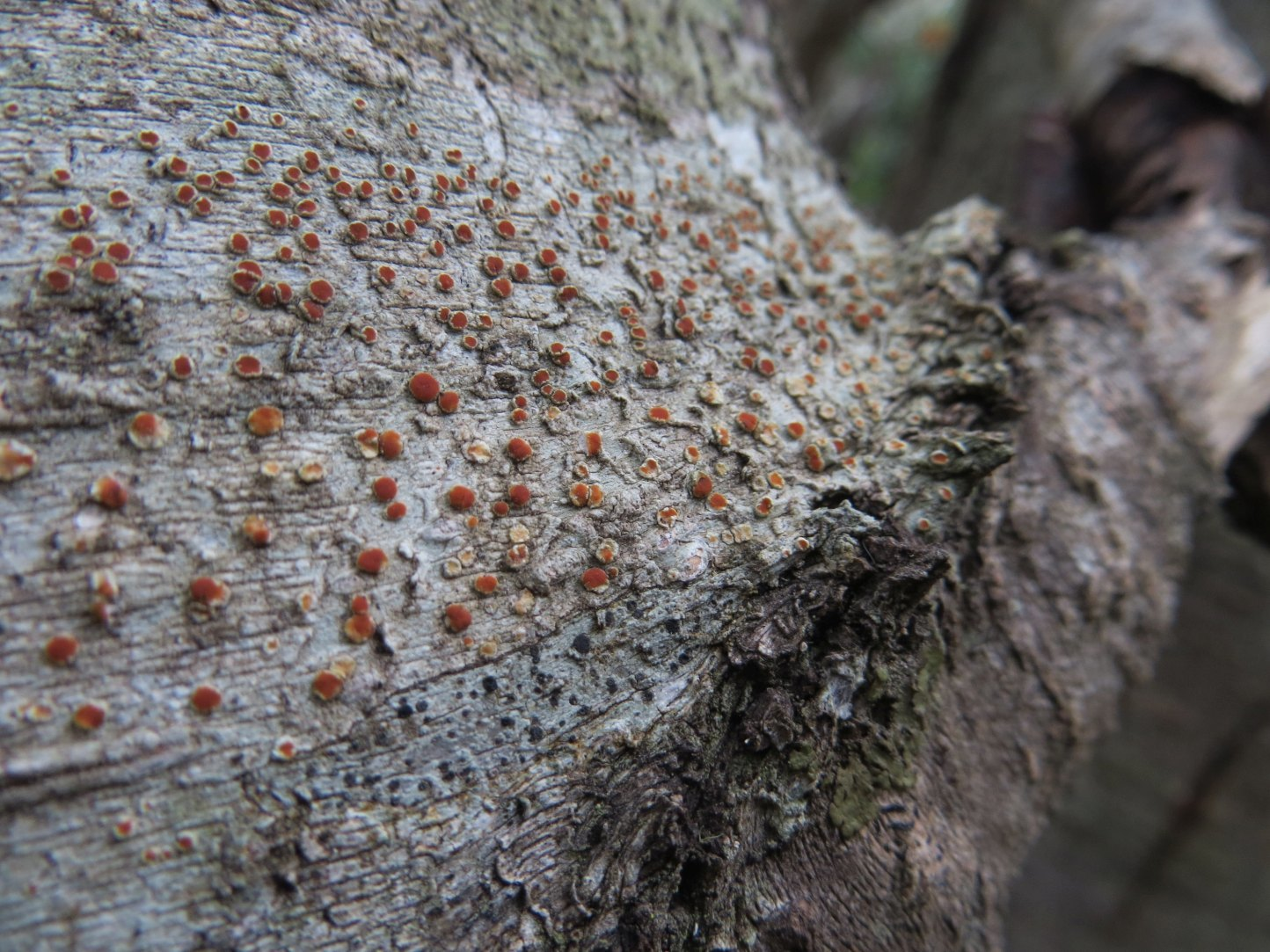
Candelariella magellanica Etayo sp. nov. is a sulphur-yellow corticicolous lichen producing powdery propagules known as soredia, rather than conventional fruiting bodies. It colonises the bark of old Nothofagus pumilio in the deciduous forests of Navarino, at altitudes ranging from 86 to 560 metres. The formal description distinguishes it from the closest related species, Candelariella xanthostigmoides, by larger-diameter apothecia and spores frequently divided into two cells.
To the naked eye, C. magellanica appears as a thin layer of yellow powder on bark — virtually invisible without a hand lens. Yet it is present on numerous trunks in N. pumilio forests across the island, as observations along the Cerro Bandera, Cerro Ukika, and Lago Róbalo trails confirmed. It is precisely this visual inconspicuousness that explains why this locally frequent species remained unknown to science until 2021.
Sclerococcum nothofagi: an undescribed saprobic fungus
The second new species described in the catalogue is a saprobic fungus — not a lichen but a fungus associated with lichens — named Sclerococcum nothofagi Etayo sp. nov. It grows on the thick, aged bark of Nothofagus pumilio, alongside corticicolous lichen species. Its muriform spores (forming a network of cells) distinguish it from all known species in the genus. Its name directly references its exclusive substrate: the bark of southern beeches of the genus Nothofagus.
Alongside these two new species, Tremella haematommatis Diederich was recorded for the first time in South America, parasitising Haematomma nothofagi — itself a lichen endemic to Nothofagus forests.
A confirmed lichen hotspot
The 2021 catalogue demonstrated that the Cape Horn Biosphere Reserve is not only a global hotspot of bryophyte diversity — already established by the Omora Park team's earlier work — but also a first-order lichen hotspot for the Southern Hemisphere. The authors note that only the northern and northwestern half of the island was covered during both campaigns; the southern section, logistically difficult to access, remains to be surveyed and likely holds further discoveries.
The ecotourism with a hand lens developed at Omora Park now guides visitors towards these barely visible yellow coatings on lenga trunks, revealing to them that they are looking at a species known nowhere else on Earth — an invitation to shift perceptual scale in one of the remotest places on the planet.
Bibliography
Etayo J., Sancho L.G., Gómez-Bolea A., Søchting U., Aguirre F. & Rozzi R. (2021). Catalogue of lichens (and some related fungi) of Navarino Island, Cape Horn Biosphere Reserve, Chile. Anales del Instituto de la Patagonia, 49. https://doi.org/10.22352/AIP202149013
Etayo J. & Sancho L.G. (2008). Lichenicolous fungi from the Southern Hemisphere. II. Some new species and records from South Shetland Islands, South Georgia Island and Tierra del Fuego. Nova Hedwigia, 86 : 135–172.
Goffinet B., Rozzi R., Massardo F., Buck W. & Leiva M. (2012). Miniature Forests of Cape Horn: Ecotourism with a Hand Lens. University of North Texas Press.
Redón J. & Quilhot W. (1977). Líquenes del archipiélago del Cabo de Hornos. Boletín del Museo Nacional de Historia Natural de Chile, 35 : 53–71.
Rozzi R. et al. (2008). Changing lenses to assess biodiversity: patterns of species richness in sub-Antarctic plants and implications for global conservation. Frontiers in Ecology and the Environment, 6(3) : 131–137.
An exceptional sale of Yagan craftsmanship: whalebone harpoons and coihue-bark canoes signed by José
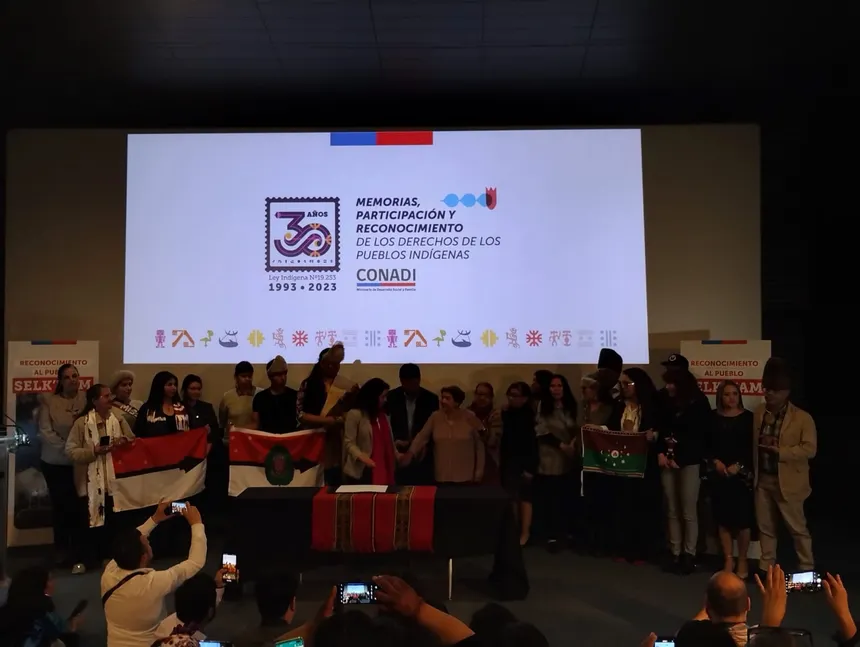
Chile recognises the Selk’nam as a living indigenous people
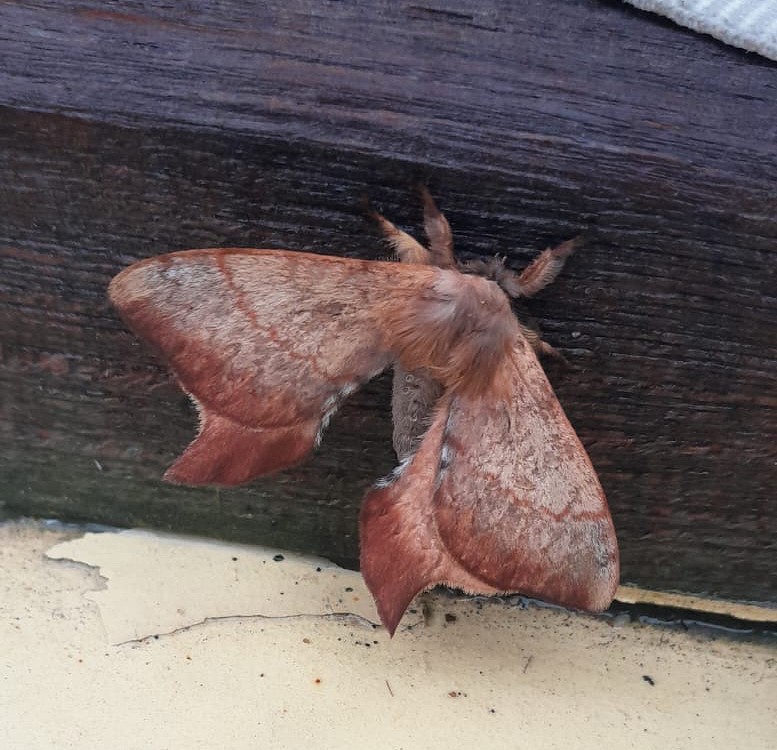
Cercophana frauenfeldii Felder, 1862 (Lepidoptera: Saturniidae): Taxonomy, Ecology and Presence in the Far South of Chile
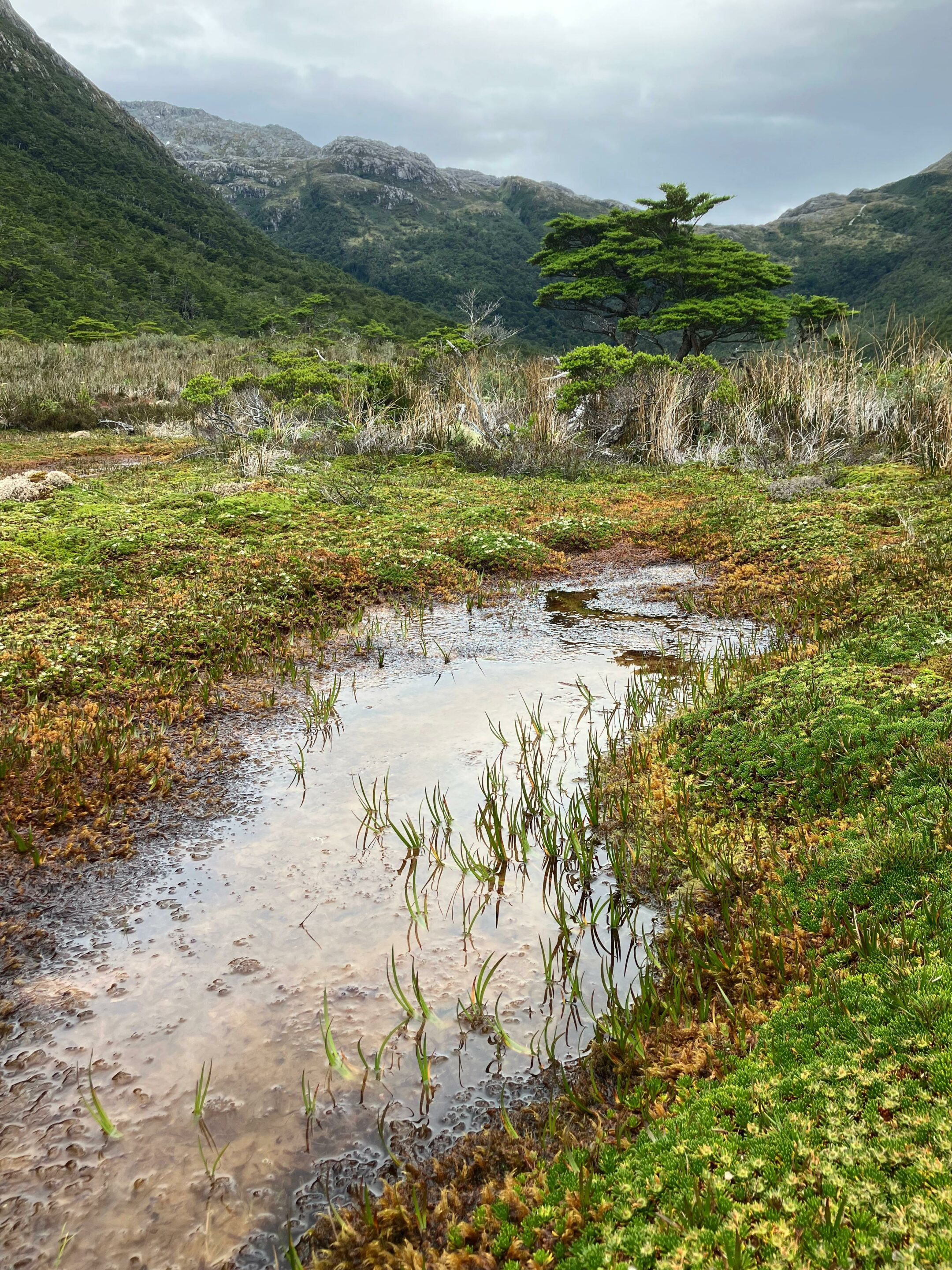
Peatlands of Tierra del Fuego: peat mosses and liverworts, the silent architects of the austral bogs
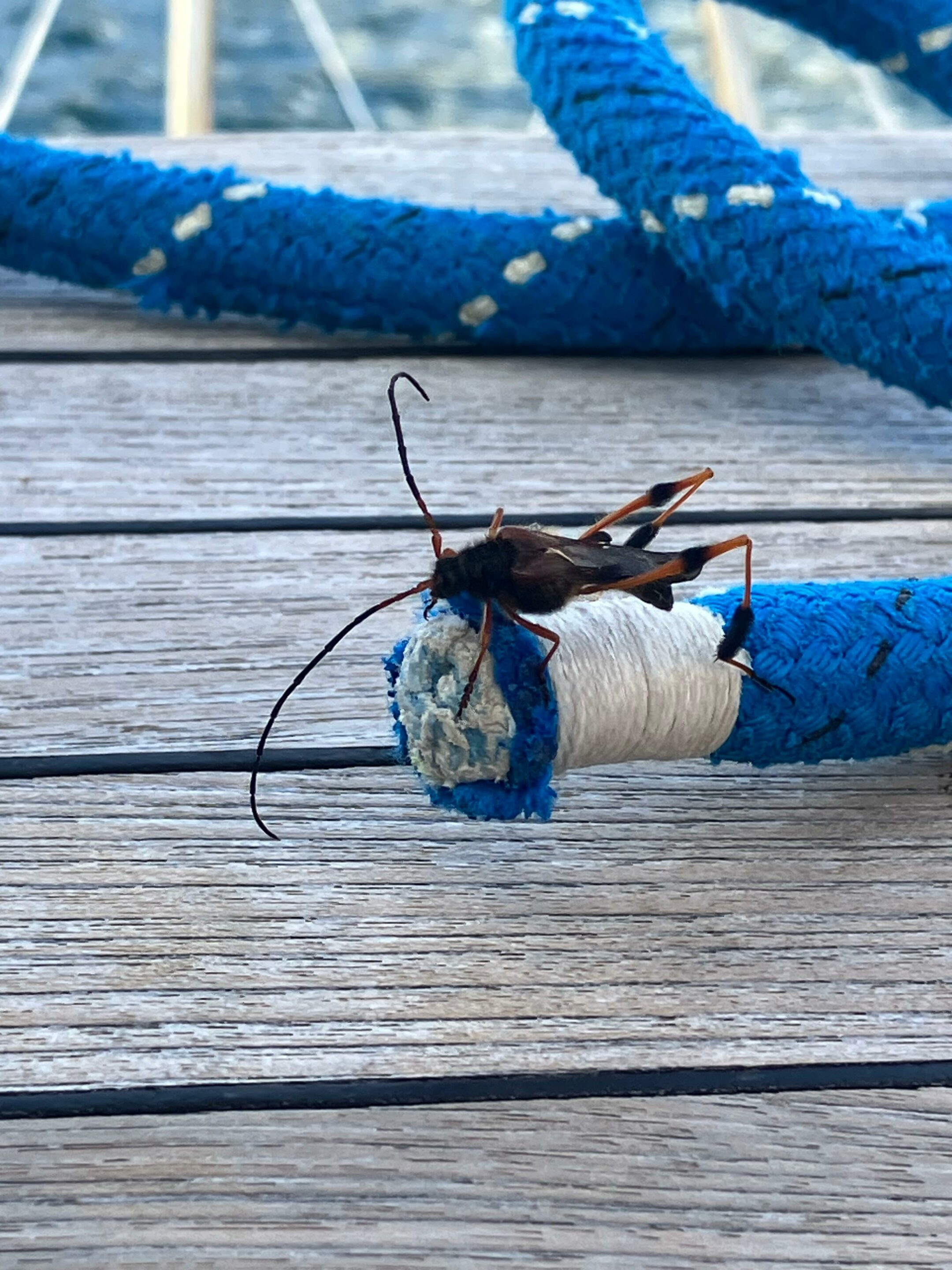
Callisphyris leptopus Philippi, a visitor during the southern storms