Callisphyris leptopus Philippi, a visitor during the southern storms

Karukinka
24 April 2026

Association Karukinka
Law 1901 - of General Interest
Latest news

Follow us
At first glance, this insect might look like a slender wasp lost far from its nest. Yet, this specimen observed aboard the Milagro on April 9, 2026, north-east of Hoste Island—while the ship was anchored in a forest-lined area battered by bad weather—belongs to an entirely different world: that of the southern longhorn beetles, which remain very poorly documented.
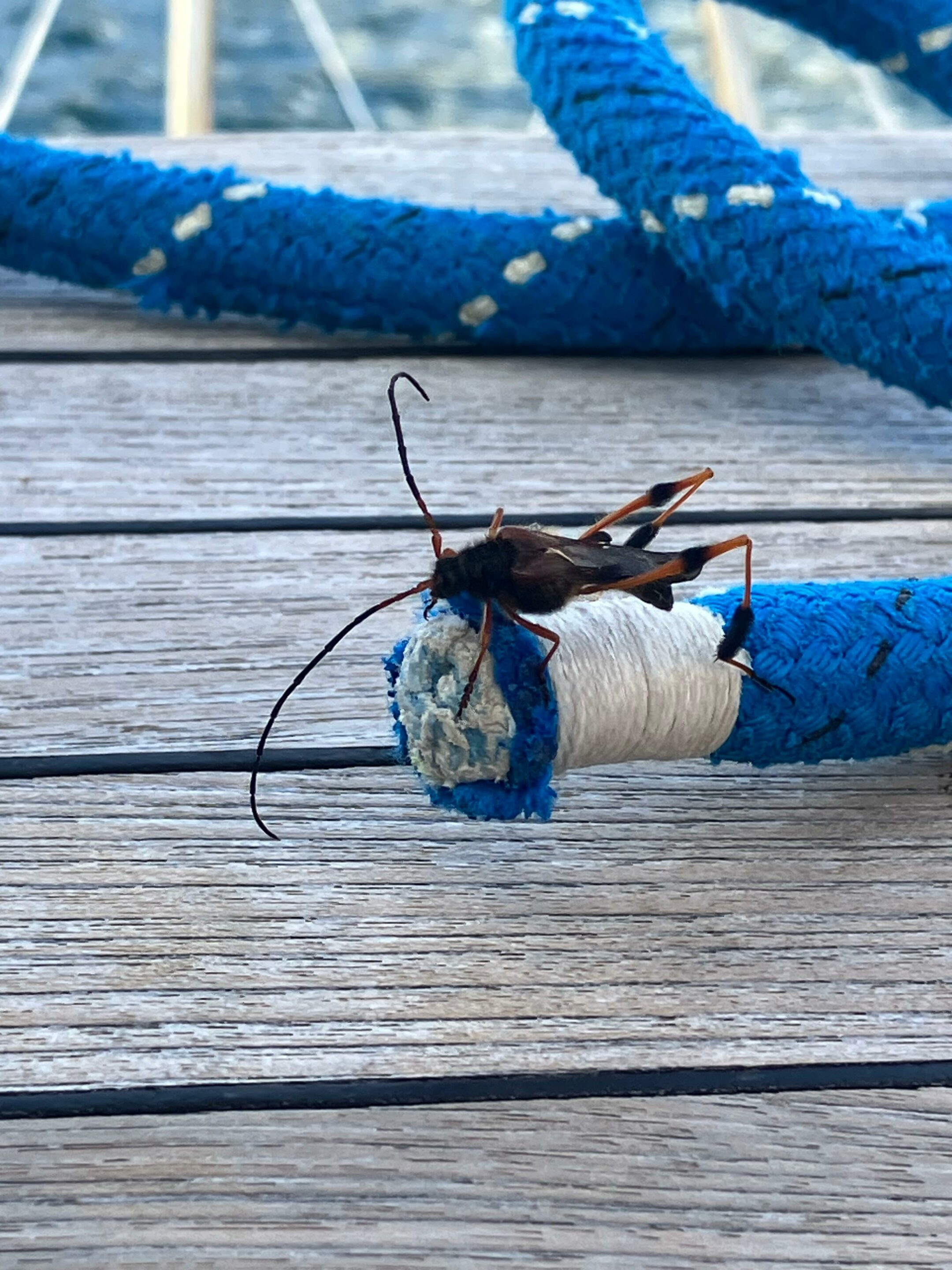
In this context, the encounter takes on real scientific significance. Callisphyris leptopus Philippi, 1859 belongs to the Cerambycidae, the "longhorn beetles," a family of beetles of which many species spend a large part of their development inside wood. The case of this species is particularly interesting because, despite its spectacular appearance, easily accessible documentation remains fragmentary, scattered among taxonomic records, forestry publications, and isolated sightings.
A species of the southern forests
Available sources place Callisphyris leptopus in southern America, with an established presence in Chile and the subantarctic forests of southwestern Argentina. The FAO forestry manual dedicated to insects damaging branches, shoots, and seedlings specifies that the species is reported in Chile from the Maule region down to Magallanes and the Chilean Antarctic, as well as in Argentina within the subantarctic forests.
This distribution is not insignificant. It associates the insect with the cold temperate forest landscapes dominated by Nothofagus, an emblematic group of trees in subantarctic and Andean Patagonia. The Titan-GBIF page also explicitly links to a "Plants" section, indicating that understanding the species requires looking at its close ties with its host plants.
Well-identified forest hosts
The consulted forestry literature associates Callisphyris leptopus with several species of Nothofagus, notably the coihue, raulí, lenga, and ñirre. The larvae develop in branches or young stems, where they burrow galleries in relatively soft woody tissues.
An Argentine article detailing an individual found south of Ushuaia provides a very concrete testimony on this matter. The consulted experts describe the insect as a "perforador o taladrador de madera" (wood borer or driller), which "por lo general hace túneles en maderas jóvenes y blandas" (generally makes tunnels in young and soft wood) and is usually linked to the ñirre, without excluding the lenga as a possible host plant in this instance.
Size, shape, and mimicry
The adult has an elongated body and a unique silhouette, very different from the common image of a stocky beetle. According to the forestry record, the female reaches about 36 mm in length and 8.5 mm in width, while the male measures about 26 mm long and 6 mm wide. These dimensions belong to a visible, yet not massive insect, whose long legs further accentuate the impression of slenderness.
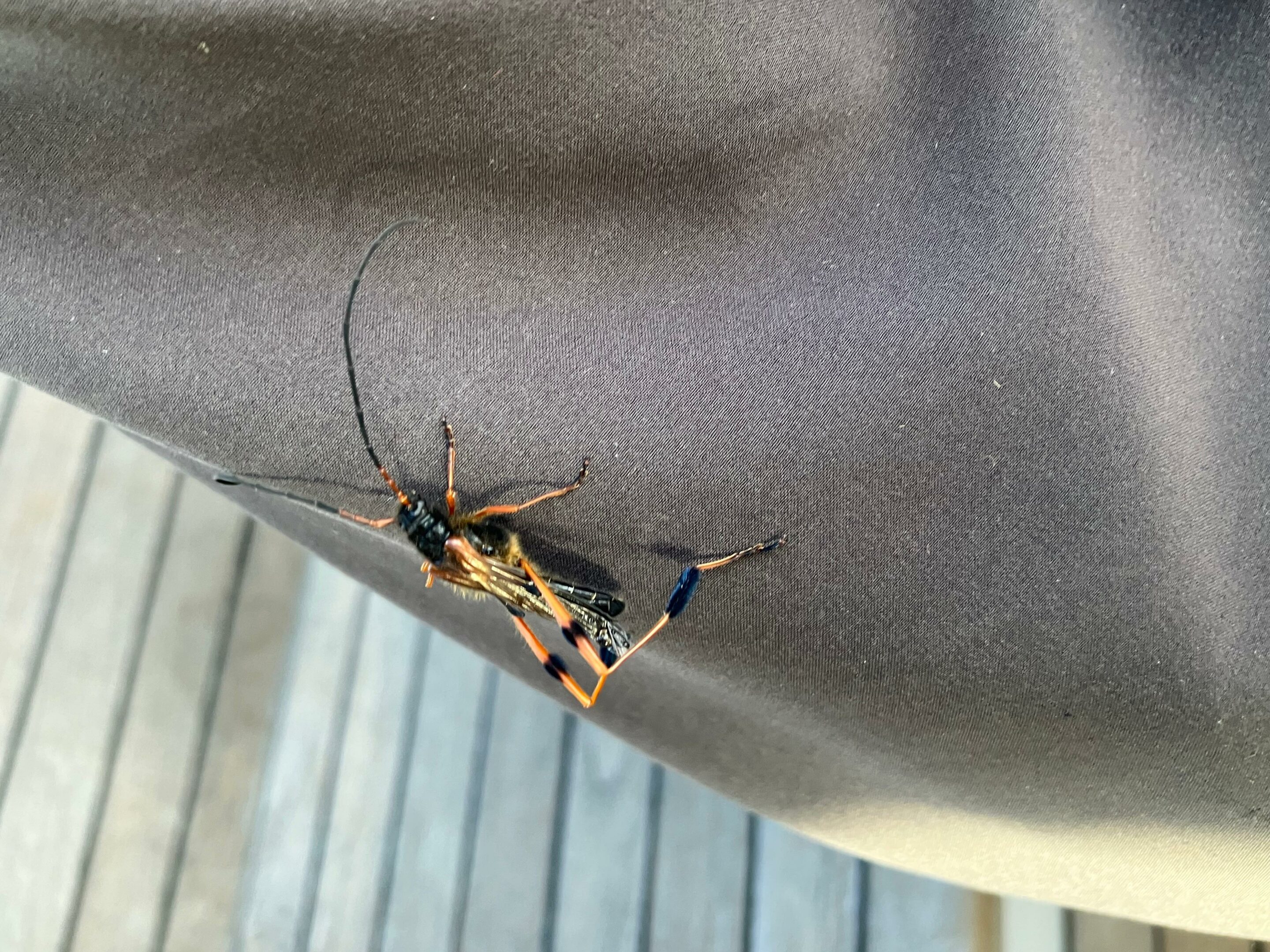
Its appearance is one of its most striking features. The article published in Argentina highlights that this cerambycid beetle "trata de imitar al de las avispas" (tries to mimic the appearance of wasps), explaining that this mimicry serves to deter potential predators such as birds or small mammals. The Titan-GBIF page reinforces this interpretation down to the species' etymology: leptopus derives from the Greek leptos ("thin, slender") and pous ("foot"), literally meaning "with slender legs."
A largely hidden life cycle
Like many longhorn beetles, Callisphyris leptopus spends most of its life out of human sight. The larval stage takes place inside the wood, in galleries that can be long and winding. The FAO document mentions a biological cycle of about four years, with larvae developing in twigs and branches before the adults emerge in spring.
The article from Diario Prensa Libre completes this picture with more accessible field observations. The experts state that the insect can "vivir dos o tres años en el interior del árbol, haciendo galerías" (live two or three years inside the tree, making galleries), before emerging to reproduce and die. Even though exact durations vary according to sources, they all agree on one essential point: the adult is only a brief apparition at the end of a long, hidden existence within the tree.
A harmless but precious insect to observe
The Argentine article identifies the specimen observed in Ushuaia as an adult female, recognizable notably by the absence of the divided antennae attributed to the male in this account. It also mentions a remarkable detail: the legs bear hairs "like little brushes," to which fungal spores can adhere, later deposited on rough surfaces or in cavities during egg-laying.
The same article emphasizes an important point for the general public: the insect does not sting and poses no danger to humans. If an individual is encountered, the best course of action is simply to let it go on its way.
Why the observation aboard the Milagro matters
An insect found aboard a sailboat or an anchored ship might seem like a mere anecdote. In the case of Callisphyris leptopus, it is, on the contrary, a data point that deserves to be preserved, described, and placed in its ecological context. The species remains scarce in accessible synthesis literature, even though it possesses a distinctive morphology, a long life cycle, and a close link to southern forests that are themselves difficult to fully inventory.
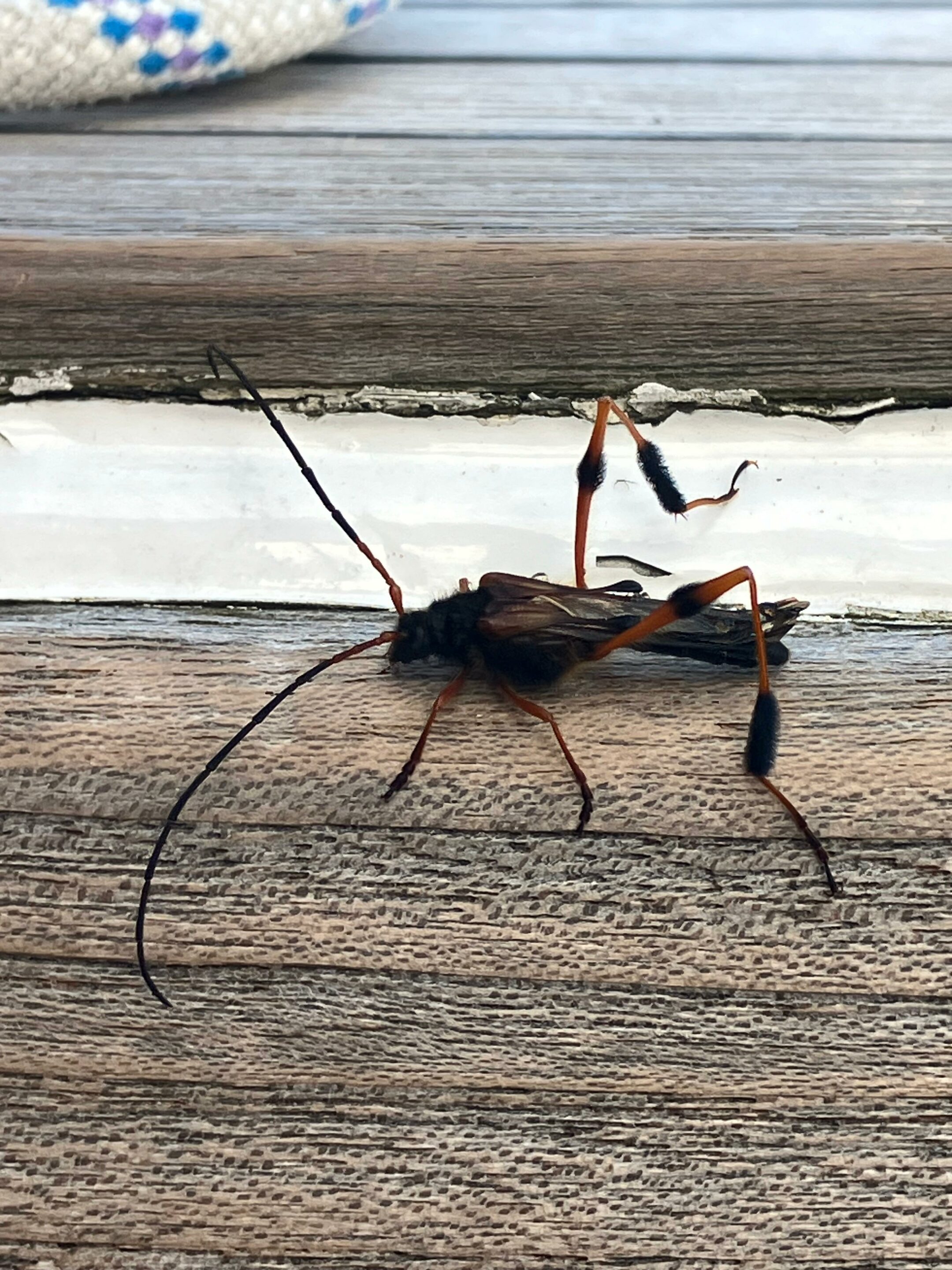
The context of the sighting further enhances its interest. A specimen landing aboard the Milagro during a storm, in a location bordered by forests, suggests movement facilitated by the wind or by adult flight activity in the immediate vicinity of its forest habitat. Without turning an isolated observation into definitive proof, this type of encounter reminds us how crucial naturalist exploration remains in the southern archipelagos, channels, and forest edges, where much data still relies on chance discoveries rather than continuous monitoring series.
In southern regions, where weather conditions often complicate fieldwork, every well-dated, localized, and illustrated observation can significantly enrich the knowledge of still poorly monitored species. The visit of Callisphyris leptopus aboard the sailboat Milagro is therefore not just another curiosity: it is a clear reminder that exploration remains a method of knowledge-gathering, sometimes triggered by a simple flutter of wings in the heart of a storm.
Bibliography
- Diario Prensa Libre. "Vecino encuentra en su jardín una 'callisphyris leptopus Philippi'". Press article accessed online.
- FAO. Insectos dañadores de ramas, brotes y plantulas. Technical manual mentioning Callisphyris semicaligatus as a synonym and describing its distribution, host plants, morphology, and biological cycle.
- GBIF Backbone Taxonomy. Callisphyris leptopus F. Philippi, 1859, species profile and occurrences.
- Titan / GBIF France. "Cerambycidae (Longhorns)", record for Callisphyris leptopus R. Philippi, 1859, with etymology and access to distribution and host plant sections.
- Coleoptera Neotropical. Callisphyris leptopus Philippi, 1859:673, taxonomic and synonymic record.

The Ley de Glaciares in Argentina (Glacier Law): context, reform, and resistance

Karukinka at the UNESCO Inclusive Toponymy Colloquium in Montpellier
The Southern Cross, celestial companion of our sails in the southern hemisphere

Cape Horn au Long Cours (CHLC): The fascinating historical work of a team of volunteers
The Rayadito – Aphrastura spinicauda: an emblematic passerine of Patagonian forests and Cape Horn